
According to the latest national accounts data published bythe FSO (January 2021), Neuchâtel’s economic growth, as measured by its GDP, stood at +5.1% in 2018, marking the highest cantonal increase in the country.
At 16.5 billion francs, Neuchâtel’s GDP accounts for 2.3% of the national GDP. Relative to its population, Neuchâtel’s GDP stood at 93,300 francs per capita in 2018, compared with 84,500 francs per capita nationally. It ranks first in Western Switzerland.
Daniel Kaufmann, an assistant professor at the University of Neuchâtel, comments on these findings for the economics section.
What can be said about this growth rate, which is more than 5 percent higher than the national and international growth rates?
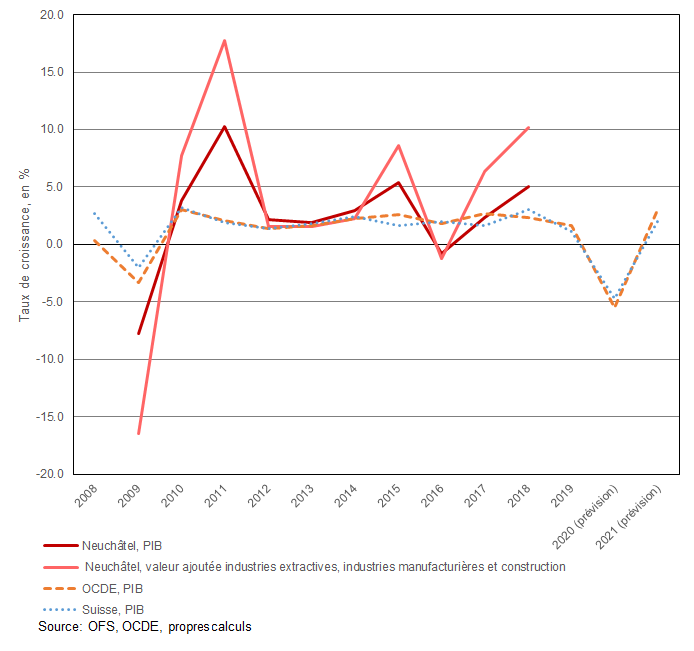
These figures show that Switzerland is an open economy. The country earns about one out of every two francs by selling goods and services abroad. However, the canton of Neuchâtel is even more open than Switzerland. Its economy is heavily dependent on the economic cycle abroad. In 2018, GDP in OECD economies grew by 2.3%, while the Swiss economy grew by 3%. As a result, the canton of Neuchâtel benefited even more from the strong economic conditions abroad, with a growth rate of 5.1%.
How do you explain such dynamism?
2018 was a good year for the global economy and foreign trade—and therefore, in particular, for the canton of Neuchâtel. Since Neuchâtel’s GDP growth fluctuates significantly over time because the economy is heavily dependent on foreign trade, it is quite possible that the COVID-19 crisis will severely hamper the canton’s growth in 2020. By way of comparison, during the financial crisis—when global GDP declined at a rate similar to that seen during the COVID-19 crisis—Neuchâtel’s GDP fell by 7.7%. At the same time, Swiss GDP declined by only 2.1%. We should therefore expect weaker figures for 2020.
Does the canton's industrial character play a major role in this growth?
The manufacturing sector is the most important sector in the canton of Neuchâtel. The extractive industries, manufacturing, and construction together account for nearly 50% of Neuchâtel’s value added. In all other cantons, except Basel-Stadt and Jura, the manufacturing sector’s contribution is lower. Furthermore, these sectors are heavily dependent on global economic growth. This is the main reason why the Neuchâtel economy is strongly affected by fluctuations in foreign trade.
According to statistical models, what kind of economic recovery is expected in Switzerland, and more specifically in Neuchâtel?
My forecasting model is based on GDP figures for Switzerland (which are already available through 2020) and SECO’s Swiss GDP forecasts (for 2021 and 2022). This model focuses on GDP growth and value-added growth in the extractive industries, manufacturing, and construction sectors in the canton of Neuchâtel.
It takes the following form.
NE(t) Growth = -5 + 3*Swiss Growth(t) + 1.5*Swiss Growth(t-1) + unknown factors
This model explains approximately 70% of the variation in Neuchâtel's growth.
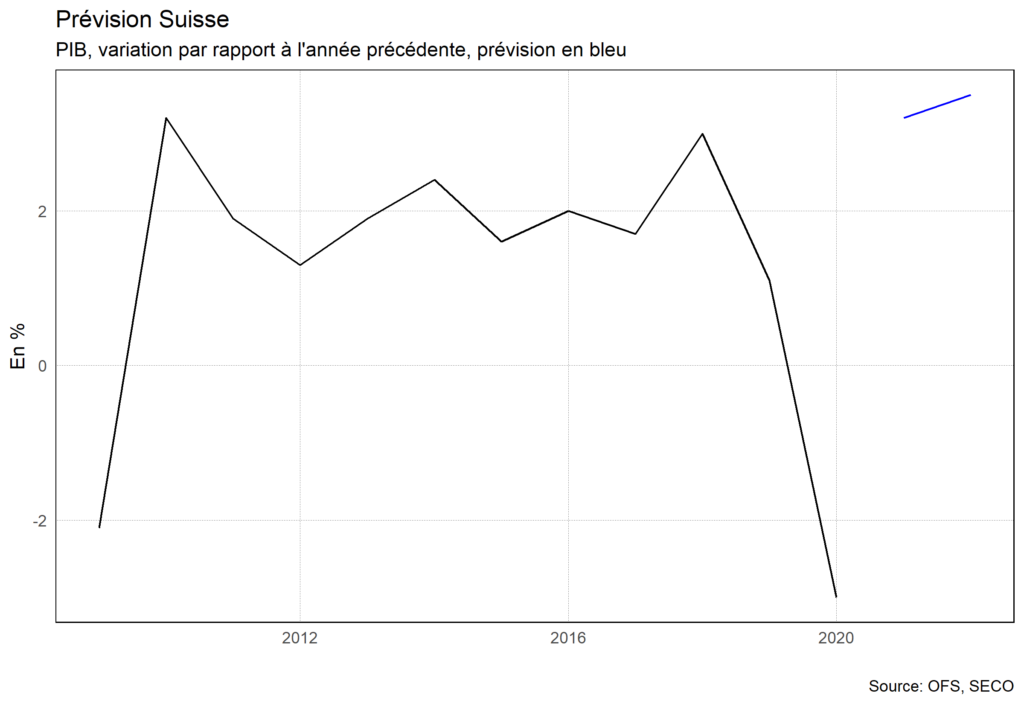
This first graph shows the official Swiss GDP growth figures from the FSO along with SECO’s forecast. These figures serve as the basis for my forecasts for Neuchâtel.
The two charts below show the forecasts for Neuchâtel. As you can see, according to the model, GDP and value added fell sharply in 2020. In 2021, the model predicts stagnation. Growth will not turn positive until 2022.
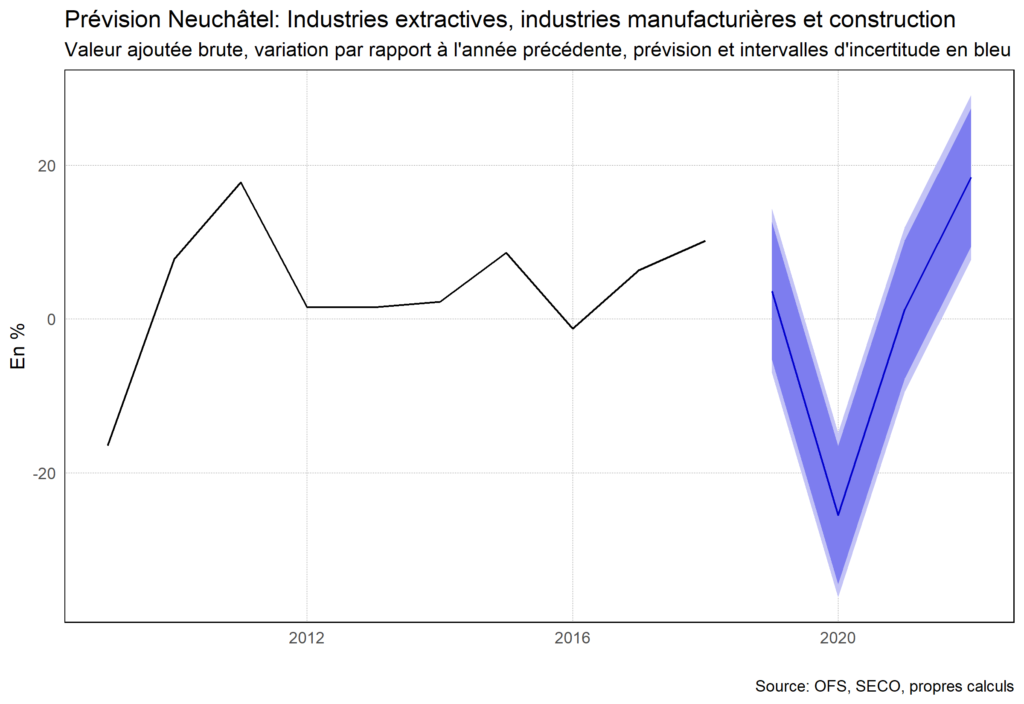
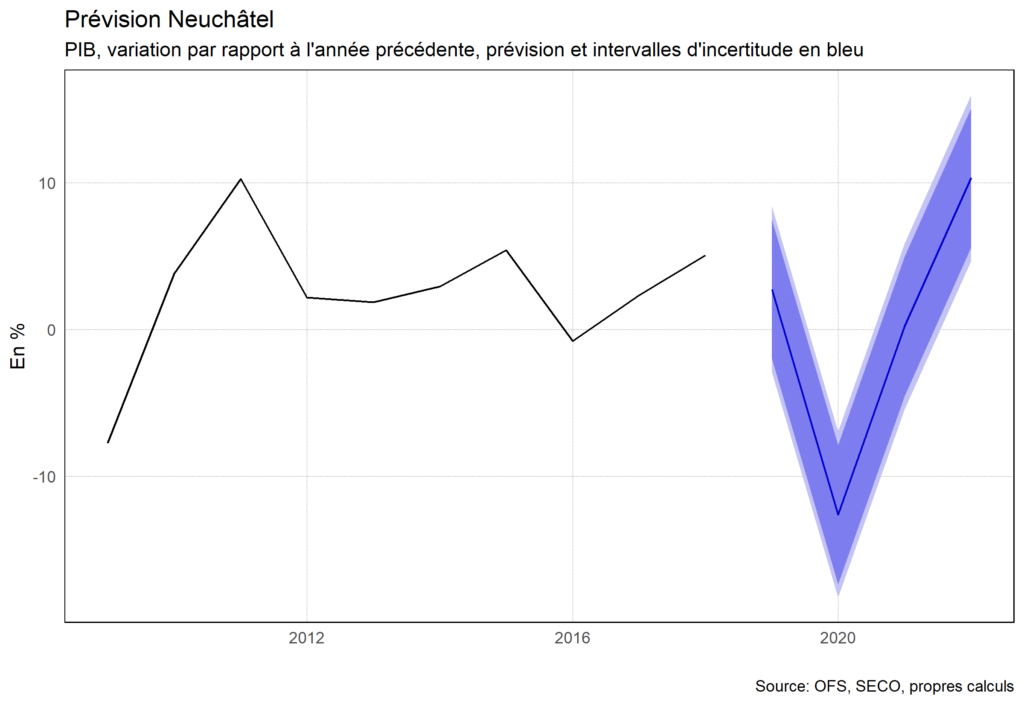
Of course, these forecasts are subject to significant uncertainties, as many factors remain unknown at this time.
How do you envision the post-COVID-19 recovery?
Foreign trade was primarily affected during the first half of 2020. This means that the canton of Neuchâtel will likely see sharply negative growth in 2020, although we will have to wait for the official figures. However, the global economy has also rebounded quickly, according to OECD figures. I find it hard to imagine that foreign trade—with the exception of a few sectors such as tourism—will be permanently affected by the COVID-19 crisis. Furthermore, economic stimulus programs, especially in the United States and the European Union, will support global growth. Ultimately, if vaccines are distributed quickly and are effective against new variants of the virus, countries in the Global North will be able to return quickly to a relatively normal economic functioning (this will likely not be the case for some countries in the Global South). All in all, I believe the crisis is not as severe as the grim economic scenarios published a year ago. However, it is still too early to assess the medium-term impact—particularly on the productivity of businesses that must adapt to a new world where future pandemics cannot be ruled out.