
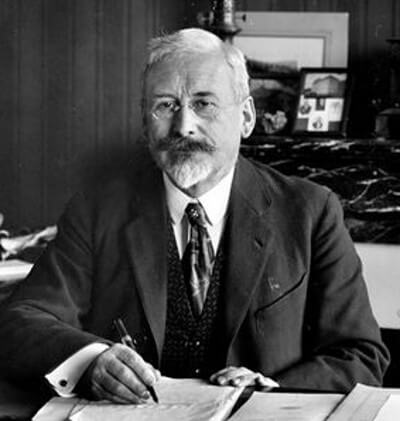
If you take a stroll through the streets of La Chaux-de-Fonds, chances are you’ll come across the name Charles-Edouard Guillaume. Does that ring a bell? It shouldn’t. This low-key researcher from Neuchâtel played a crucial role inthe 19th century in the rise of precision watchmaking. The inventor of two families of alloys still in use today, this native of Fleurier received the ultimate honor in 1920 for his lifetime of discoveries: the famous Nobel Prize in Physics.
An unexpected but flawless journey
In the heart of the Neuchâtel Valley, Charles-Edouard Guillaume (CEG) spent his entire childhood in his father’s watchmaking workshop. Though destined to follow in the family’s watchmaking tradition, the young man chose to pursue physics after graduating from high school. After earning a doctorate at the Swiss Federal Institute of Technology in Zurich, he discovered a passion for metrology, the science of measurement.

Hired directly by the International Bureau of Weights and Measures in Sèvre, near Paris, it was his work on thermometry—the science of measuring temperature—and his attention to detail that earned him a reputation.
While units of time, measurement, and temperature used to vary from country to country or region to region, CEG will offer simple points of comparison that everyone can relate to, such as water.
says François Goetz, a professor at HE-Arc Engineering in Neuchâtel,
Faced with a veritable void in the field of units of measurement, Charles-Edouard Guillaume and the International Bureau of Weights and Measures provided solutions, such as the establishment of master standards. This globally recognized organization, where CEG would work for more than fifty years, subsequently appointed him director from 1915 to 1936. “It was this desire to achieve highly precise measurements that led CEG to conduct his research on the alloys that would make him famous,” says François Goetz.
Groundbreaking discoveries
In fact, it was in an effort to solve problems in metrology that Charles-Edouard Guillaume embarked on the painstaking quest to find materials resistant to temperature changes. Before his discoveries, when, for example, a metal bar in Switzerland was found to measure one meter, the same object in Africa would expand due to heat, causing its size to change.
In order to measure these units consistently, CEG tested more than 600 alloys and finally developed invar (short for “invariable”) in 1896. Composed of iron and nickel, this material was finally resistant to any expansion—or at least proved to be ten times less prone to expansion than the metals of the time. Obsessed with measurement perfection, CEG then created a second nickel-chromium alloy with constant elasticity, known as Elinvar (short for “invariable elasticity”).
These discoveries would finally bring him closer to the world of watchmaking. The accuracy of pendulum clocks—which depends on the length of the pendulum rod—benefited significantly from these advances. Since these metal rods were sensitive to heat, they would expand on very hot days and, as a result, run slower than normal. The discovery of invar would revolutionize the watchmaking industry, which could now offer pendulum rods that no longer required frequent adjustments.
As for Elinvar, it is wristwatches that will benefit from it. Since the timing of these timepieces is determined by a balance spring (a type of wheel connected to the balance wheel by a steel spring that moves back and forth), when temperature fluctuations occur, the spring softens. Thanks to the use of Elinvar, the spring’s elasticity remains constant, and the watch’s timekeeping mechanism maintains its accuracy. The invention of Elinvar thus enabled timepieces to become 10 to 50 times more accurate. Even today, most mechanical watches are equipped with balance springs made of an alloy similar to the one discovered by CEG.
Alloys That Are Still Part of Our Daily Lives
In addition to watches, Charles-Edouard Guillaume’s work can be found in many other applications. Once used for lighting, this metal—which does not expand—found a use in incandescent light bulbs, where the temperature rises due to the electric current. It was also used in the cathode-ray tubes of older-generation televisions.
Invar was also used, in particular, to solve an engineering problem with the Eiffel Tower. A wire was stretched from the ground to the second floor of the monument to analyze its deformation due to temperature and observe how it behaved under the influence of the wind,
says Professor François Goetz. In geodesy, too, the invar has proven its worth in determining the shape of the Earth with even greater precision.

Today, one of the major applications of CEG’s research—aside from mechanical watches—is in the tanks of LNG carriers. These ships, which transport liquefied methane at minus 162 degrees—much like a giant thermos—must withstand any form of expansion. Ultimately, all these real-world applications are simply a testament to the ingenuity demonstrated by the unassuming scientist Charles-Edouard Guillaume.
These works achieve a level of perfection that is virtually unmatched today,
notes François Goetz. Although CEG remains anonymous, his work continues to be celebrated at the foundation bearing his name, located in La Chaux-de-Fonds.
Key Dates:
1861: CEG was founded in the canton of Neuchâtel
1878: Admitted to the Swiss Federal Institute of Technology in Zurich
1883: Joined the International Bureau of Weights and Measures
1895: Development of invar
1919: Development of Elinvar
1920: CEG wins the Nobel Prize in Physics
1938: CEG dies in Sèvres, France
Article by Julie Müller