
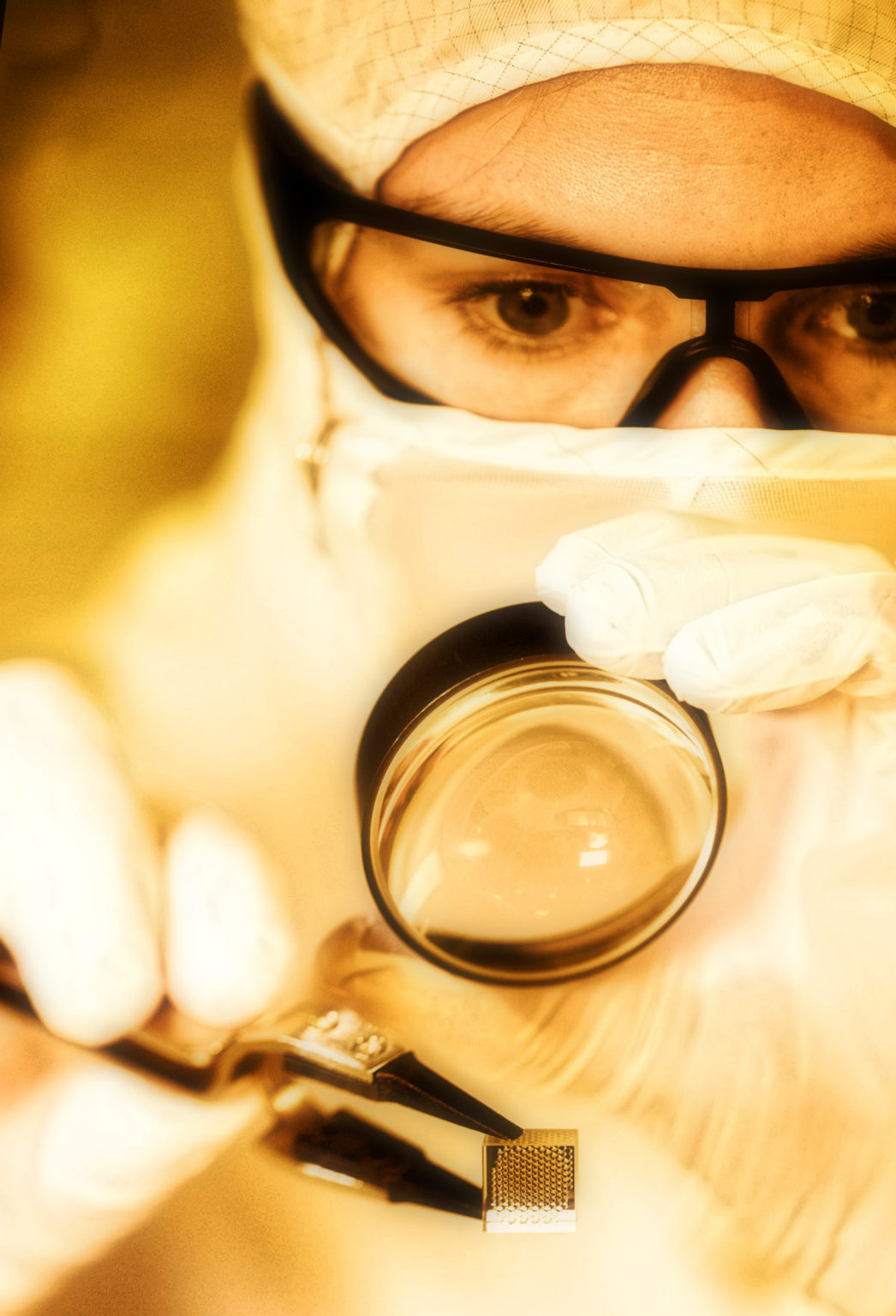
SUSS MicroOptics, which has been operating in the canton for more than 20 years, is a major player in the photonics and micro-optics industry.
Interview with the company's CEO, Dr. Reinhard Völkel
How has your business grown in the canton?
After completing my Ph.D. in micro-optics in Germany, I arrived in Neuchâtel in 1994 for a postdoctoral fellowship at the IMT (Institut de Microtechnique), which was formerly located at the University of Neuchâtel and has since been incorporated into EPFL Neuchâtel.
In 1999, we founded a spin-off of the IMT thanks to an investment from the German company Suss MicroTec.
In 2012, we moved to Innoparc, where we invested five million in a new production facility. Today, we employ 120 people.
Our revenue grew from 16 million CHF in 2018 to 26 million in 2019, generated through a portfolio of more than 180 clients worldwide.
This year, we are building a new production facility in the Innoparc IV building at 39 Rue de la Pierre-à-Mazel. This will be our second 800-square-meter cleanroom.
In 2017, we entered the automotive lighting market. The rest of our business focuses on fiber splicing, telecommunications, and semiconductors. 10% of our business is dedicated to the medical sector, such as endoscopes and Nipkow discs, which are used in confocal microscopes for the optical analysis of medical tissues.
How did you cope during the COVID-19 pandemic?
The COVID-19 crisis will have significant repercussions on our company’s operations (revenue, cash flow, etc.) in 2020.
Our main customer, Valeo (BMW), which accounted for 45% of our total annual revenue in 2019, was forced to halt production for two months. We implemented reduced working hours (RHT) for 50% of our staff. Construction of the new cleanroom (Innoparc IV) was delayed by two months because our supplier, based in Italy, was unable to deliver the necessary equipment. Fortunately, none of our employees fell ill.
We quickly implemented all health and safety measures and encouraged our employees to work from home.
During this health crisis, we received numerous orders for microlenses used in fiber-optic connections in data centers.
How do you approach innovation within your company?
Innovation is very important to us. We have excellent relationships with EPFL, CSEM, and research centers in Switzerland.
In fact, together with CSEM, we were awarded a major European project called PHABULOuS, involving 20 partners and 15 million euros in funding. We will be hosting the new European pilot line, which will provide highly advanced and robust manufacturing technology for free-form optical microstructures in Neuchâtel.
We are working on headlamps (Micro-Optics Headlamp Lucid) for cars. A standard headlamp consists of nearly 200 parts. With our technology, the headlamps are the size of a pack of cigarettes—they’re tiny. This is a benefit for electric cars, because by reducing the size of a component, we directly contribute to reducing the car’s weight. Currently, we have fifteen prototypes in the field of automotive lighting (new headlights and light curtains). In fact, 49% of our business is dedicated to this market, thanks in particular to the launch of a new production line for wafer-level optics (which enable the design and manufacture of miniaturized optics). The light strip is a highly visible innovation that makes a vehicle stand out when it’s equipped with one, as seen in BMW models. In fact, today’s cars—regardless of brand—are very similar in terms of safety and aerodynamics.
For our standard products—such as the microlenses we have been manufacturing for 20 years—we continue to conduct research to improve their effectiveness.
How do you envision your company in 5 to 10 years?
I think we're very well positioned in the automotive lighting market. Our core business is also growing steadily. We hope to continue this growth.
In what areas could the canton still make improvements to enhance its appeal to businesses?
I’ve given this question a lot of thought. I love living in Neuchâtel. It’s a beautiful, peaceful place with protected natural surroundings, located 1 hour and 30 minutes from Geneva and 2 hours and 30 minutes from London.
In my view, the canton of Neuchâtel could develop a “Neuchâtel Côte d’Or,” similar to Zurich’s Goldküste—an upscale area with views of the lake and the Alps to attract affluent families, most of whom currently live in neighboring cantons.