
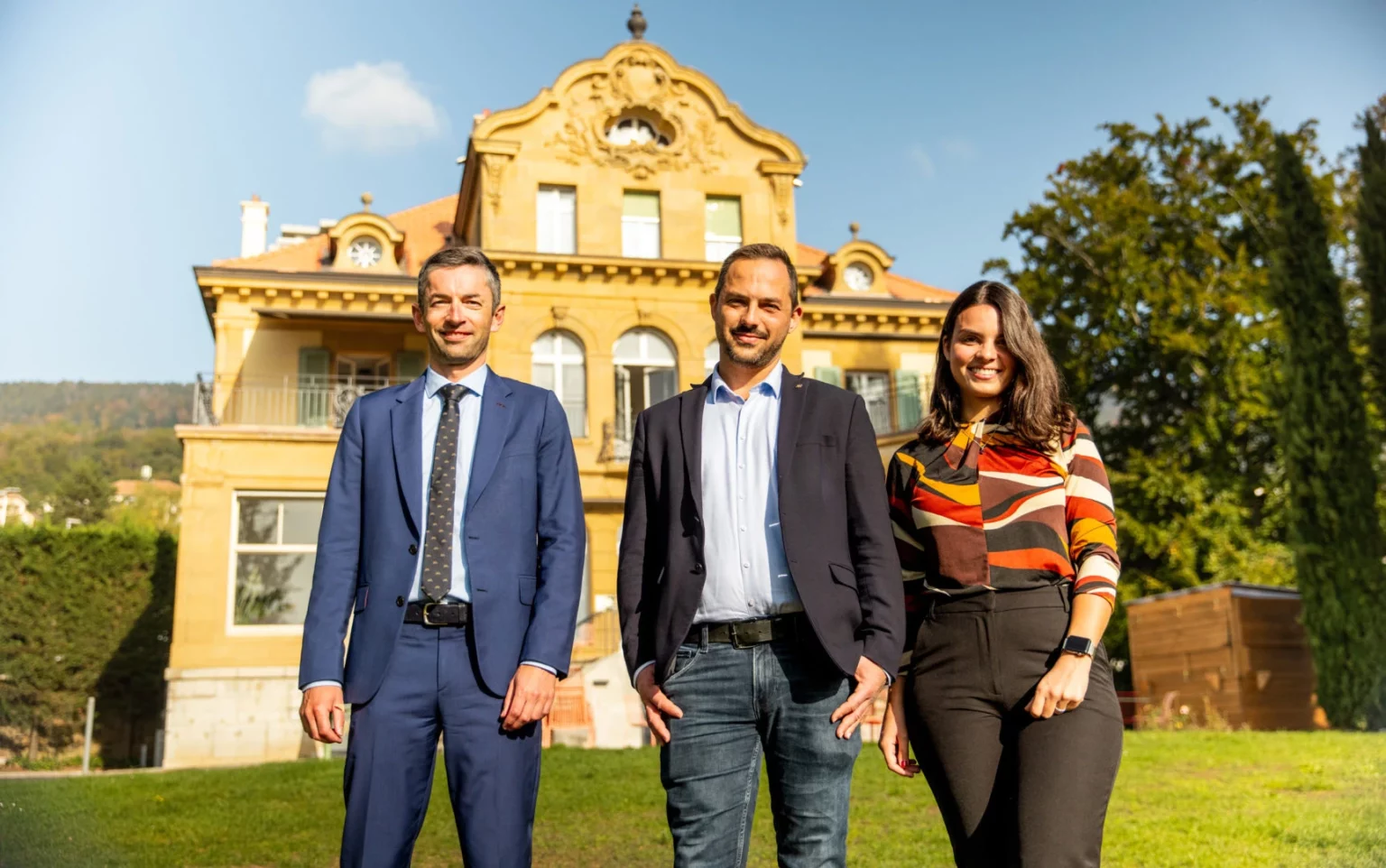
Nicolas Sarrut is the founder and CEO of the ADMCS Group in France and the DMCS Group in Switzerland. This group, which specializes in energy-positive eco-terminals for container management and software for optimizing container logistics flows, established itself in the canton in 2020. Passionate about new technologies and environmentally conscious, Nicolas has been working in the maritime container transport industry for over 23 years and is one of five European specialists in the field with a global perspective. From a very young age, he was immersed in this industry thanks to his grandfather, who, in 1960, was the first to transport containers by truck in the Grand-Est region of France.
Meet an eternal enthusiast who knows everything there is to know about multimodal containers.
How did ADMCS get started?
I started working at my grandfather’s company at a very young age, where I was able to witness the evolution of the business, the maritime industry, and new technologies. I also realized that transportation is “dirty” and that everyone views it negatively. Logistics (especially by ship) is polluting, but it’s important to realize that 90% of what humans consume—from raw materials to waste, including semi-finished and finished products—is transported by container. It is now the world’s largest industry. For several years, I’ve been wondering how I could change that. This reflection led to a two-part project: buildingeco-terminals for container management with a positive energy balance, and developing software to optimize container logistics flows based on advanced technologies such as artificial intelligence, deep learning, the IoT (Internet of Things), blockchain, and cryptocurrency. The goal is to reduce the carbon footprint of the multimodal transportation sector.
In what industry does your company operate? What services do you offer?
We’re in the container shipping and digital technology industries.
It took me a while because, in my line of work, everything is still done by phone, fax, or email using software systems that are siloed by each service provider. It’s important to understand that there are many different parties involved in moving a container from its point of origin to its destination, and each party has its own IT system. In fact, there is no single software system that manages the entire process. The idea is to get all these people to use these new technologies without causing too much frustration, so that they can be interconnected. As I mentioned earlier, the first phase of the project is the construction of eco-terminals. These are environmentally friendly ports that will utilize technologies such as solar power, wind turbines, and hydroelectricity, and will incorporate local flora and fauna into the landscaping of the site where we’ll be building. The terminals are passive; they are 100% electric and generate all their own electricity. The one we’re building in Ittenheim (Grand-Est) will even be energy-positive. We’ve just submitted the building permit application, and the project is expected to be completed by the end of 2024.
As for the second part of the project, it involves the creation of software to manage the supply chain. The goal is to sell access rights so that the various stakeholders can organize and track their containers and documents, as well as upload or retrieve documentation related to a specific container shipment from start to finish. Instead of paying with fiat currency, these individuals or companies will purchase tokens through the system. These tokens will allow them to log in to the platform, where they will have access to the information that the organizer chooses to share with them.
At the same time, we would like to offer the platform’s clients services related to financial assets. Using the DMCS token, we aim to provide “corporate” clients with “crypto bank”-style services. For private and institutional clients, we will offer brokerage services as well as a full range of asset investment services, wealth management, and more. Initially, we will establish DMCS Finance, which will serve as a licensed financial intermediary in the true sense of the term. Within a year, we will begin the application process for a banking license, which will enable us to open our crypto bank within three years.
Why did you choose the Canton of Neuchâtel as the place to set up your business and grow?
The canton of Neuchâtel chose us. A few years ago, I presented our software at STATION F, and among those in attendance was Mr. Albert Suissa from the GGBa, who invited me to GGBa Night, where I met people from the canton. They liked the project, and they were the ones who proposed that I come to Switzerland—to Neuchâtel—to develop it. I received support from the canton and guidance from FINMA. Today, that’s what has enabled us to establish the first regulated cryptocurrency platform. We work with many of the region’s key players: Le/AX Avocats, e-gestion for accounting, and Revixpert for auditing. We receive strong support from the Department of Economic Affairs and the canton. Since it was the people here who believed in us, who helped us, and who provided us with the means to get started and move forward, it only made sense to set up shop here.
Who are your main competitors and customers right now?
We had already received an offer to buy the project, but I refused to sell. So they took the idea and ran with it. They tried to do the same thing, but for now, they don’t have a framework for the business. That said, we have several shipping companies and industry players trying to acquire us.
Today, we already have more than 600 contracts for the purchase of DMCS tokens, and nearly 10% of these investments come from industry users.
How do you perceive and experience innovation within your company?
Innovation is very difficult because people think you’re crazy. For the first three years of the project, the banks turned me down. France, my home country, didn’t support me, and neither did my region. I was very surprised when Switzerland reached out to me. The seriousness of the people here is completely different, as is their open-mindedness—especially when it comes to innovation. They aren’t afraid to say they’ll support a bold project. I’ve been working on this project for nine years; I self-funded it entirely for seven years, then we raised a little “love money,” and eventually ended up in Switzerland. We secured the necessary support, and we’ve been pre-selling the tokens for about two years now.
How do you envision your company in 5 to 10 years?
In 3 to 5 years, we plan to expand the system and implement it across multiple industries. The goal is for the terminal to be up and running within 2 years, with the software also fully operational. The next step will be to replicate the system, as it was designed to be “scalable,” so we’ll be able to adapt it to all modes of transportation.
To date, we’ve already received nine requests for implementation from around the world, without any marketing efforts on our part. These requests mainly come from industry professionals who know us through major shipping companies—they’ve reached out to me—and in some cases, from governments (the United Arab Emirates, Ecuador, and the United States).
This is an environmentally friendly project. Why is that important to you?
My grandfather was a farmer and a trucker. And I grew up with him. I worked on the farm, I worked in the trucking industry, so I saw the changes firsthand. Today, without nature, we are nothing. We need transportation. In the future, transportation will need to be different—one that has no negative impact on nature. So the goal is to find innovative solutions to reconcile nature and industry. Today, I think we’re on the right track to finding solutions. This isn’t the only solution; fortunately, there will be others. I’m also open to working with anyone who shares this vision.
In what areas could the canton still make improvements to enhance its appeal to businesses?
So, honestly, when it comes to the entire process with the canton, I don’t see what could be improved—they’ve been so supportive. They’re even helping us find housing for the employees who will be moving here. You have some very talented people working for you. I even have partners who are going to follow the ADMCS project here, in part because they’ve seen what the canton has done for us. So I’m not coming alone—I’m coming with an entire ecosystem. Honestly, right now, I can’t think of anything. I’d like to thank the Canton of Neuchâtel, the Department of Economic Affairs, and especially Mr. Vradis and Mr. Mignon of Le/AX Avocats.