
Eric Marguet studied mechanical engineering in France at the Institut Universitaire de Technologie de Besançon.
He has lived in St-Imier, Switzerland, since 1995, where he continued his studies at He-Arc St-Imier (at the time, an ETS Microtechnique engineering program) and completed his education with a HES master’s degree in computer science.
He is a part-time (50%) professor of design at HE-Arc, teaching Microtechnology and Industrial Design.
What is the purpose of your company, Gravity?
Our expertise lies in the practical application of Big Data (or megadata), defined as the totality of digital data produced by the use of new digital technologies.
We observe that the physical, real-world use of billions of data points is now possible thanks to the combination of microtechnology and modern computing. This opens up new possibilities, particularly the creation of objects that are infinitely more efficient, precise, and rich—much like those found in nature, for example.
What is innovative about your approach?
Currently, in engineering, 3D objects are created by computer. Parts are generally generated from simple solid geometries. They resemble cubes, rectangles, spheres, and axes on which it is possible to perform material-removal operations, such as drilling. Another, more complex method is called surface modeling. It is used when solid modeling tools are no longer sufficient to create geometries that are too complex. It is typically found in video games, animated films, and science fiction movies. It allows for the creation of more organic shapes: airplane wings, bicycle seats, motorcycle helmets, computer mice, car bodies… Based on this surface-based technology, 3D scanners make it possible to virtually reproduce and then physically create real parts. However, even with today’s powerful computers, we are limited to a few million points characterizing an object when it is intended for manufacturing.
Our innovation does not rely on either volumetric or surface-based design. This approach makes it possible to materialize objects derived from point clouds of unlimited size. The fabrication of objects defined by billions of coordinates becomes possible—a 1,000-fold increase (to start with)—compared to current surface-based technologies. We manage big data by prioritizing optimized point sequencing for object fabrication (patented principle).
When you create a 3D map, how much data do you use?
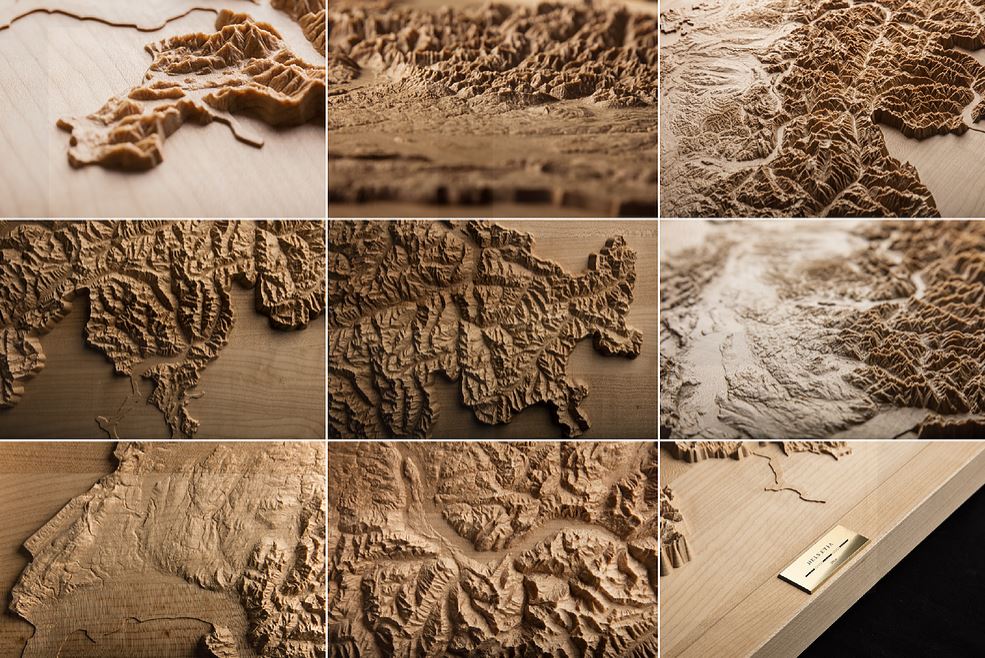
The precise representation—to the nearest meter—of Big Data derived from scanning the Neuchâtel terrain, covering 1,000 km², requires one billion coordinates. For a 70 cm x 35 cm model, this corresponds to an accuracy of 15 microns (or 0.015 mm). Visually, when viewing this model, an observer can clearly distinguish every tree in the canton. Of course, this requires the use of highly precise manufacturing techniques (watchmaker-style machining, laser cutting, controlled electrical discharge machining, etc.).
To achieve this, artificial intelligence is essential, as humans simply cannot handle such a vast amount of information on their own. Even the screen interface becomes redundant when faced with such large amounts of data.
What are the practical applications of your technology?
We’re already applying Big Data visualization to mapping. It’s our flagship product because the data is readily available. The aesthetic and visual impact is enormous, as people aren’t used to seeing artificial objects with such high definition. For the first time, the full richness of nature is captured in a human-made object. Moving forward, our diversification efforts are focused on watchmaking and architectural design. We are also exploring medical applications. Indeed, our bodies are a perfect example of extreme complexity. Integrating implants of equal definition into them seems like a logical next step.
What are the challenges at this level of precision?
The tools used on computer numerical control (CNC) machine tools—which remove material—are the size of a fly’s leg. They are custom-designed in collaboration with regional partners, such as Dixi and Fraisa. It took three years of research to develop them.
Furthermore, to manufacture a card with a precision of 15 microns from high-quality wood (oak, beech, or maple), the machine must run continuously for four weeks. Even the slightest programming error can be disastrous, as the wood will be “hollowed out” in the wrong place, rendering the map unusable. Power outages must also be avoided, because if the process is interrupted, the CNC cannot resume where it left off.
Given the amount of energy required to run the machines, we have optimized the spindles so that once they are spinning, they no longer need energy to continue rotating. Currently, we only need 1,500 watts for all of our equipment (eight machines), which is the equivalent of two microwave ovens running.
Finally, the CNC machines must operate in a controlled environment at 24.5 degrees and constant humidity. Temperature fluctuations cause the tools to expand, which in turn leads to misalignments on the circuit board being machined.
Is a computer capable of processing the available amount of topographic data simultaneously?
No, because this involves managing terabytes of raw data (one trillion), which would cause any computer designed for this purpose to “crash.” Thanks to our patented algorithms, which act as an interface between the data and the machine, only 0.001% or less of the data is transmitted to the programmer. After that, the computers and machines operate autonomously in real time. They load the data as the machining process progresses.
What factors made it easier for you to start your business in the canton?
Gravity.swiss was founded—as, it seems to me, are most Swiss technology companies — thanks to Switzerland’s unique educational infrastructure, which combines close ties to industry with research institutions. We have benefited from the IT infrastructure at HE-Arc Engineering and its researchers and students, as well as from access to the latest software and equipment available right here in the region, thanks to its microtechnology heritage.
What are the next steps for Gravity?
We completed our research and development in May of this year. Thanks to the success of our topographic maps, we have established a global, high-end market.
Now that we are profitable, we can continue to improve our technology, explore new opportunities, and take on exciting challenges.
Written by Victoria Barras