
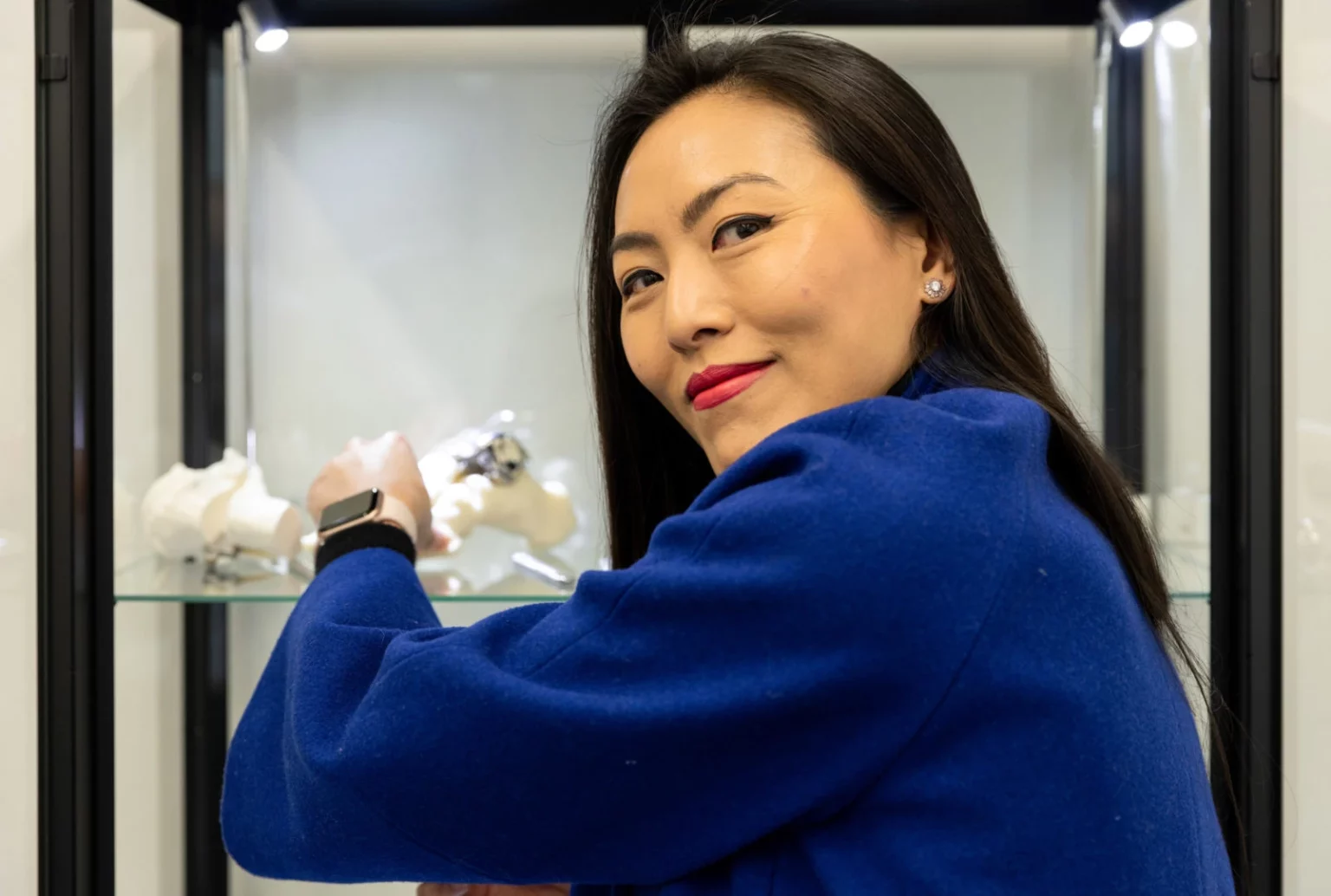
Helen Yau, director of operations at Koln3D, is originally from Hong Kong and has been living in Geneva, Switzerland, for 30 years. She came to Switzerland with her mother to escape Hong Kong’s handover to China.
After studying mathematics and computer science applied to the humanities—and completing a master’s degree in education with a focus on e-learning—Helen developed a passion for working with people and joined Koln3D, a company that offers personalized, one-stop medical solutions.
An interview with a determined woman who believes that innovation should serve people.
How did Koln3D come about?
Koln3D was founded in Hong Kong in 2015. Mr. Yau, the CEO of Koln3D, had been working in the parts manufacturing industry and became interested in 3D metal printing. At the time, one of the surgeons at a Hong Kong hospital wanted to print a custom metal talus bone. He knew Mr. Yau and had heard about his company. It was the only company in Hong Kong capable of 3D metal printing, though the prints weren’t necessarily suited for the human body. That was the beginning of the adventure. The surgery was a resounding success. The patient has been under close follow-up for several years and is doing very well.
Following this initial success, we were able to print other body parts, such as the hip, the shoulder, and the maxillofacial region.
What is the process for manufacturing parts? Do you have any specific certifications?
Each printed part is custom-made and tailored to the patient. We work with surgeons, who first explain their challenges and needs to us. We then handle the technical aspects, which encompass the entire value chain—from design to polishing and delivery to the medical community.
Once the implant is in place, the surgeon monitors the patient to see if the body will accept it.
Currently, our company provides 3D printing services exclusively for the medical field.
Several scientific studies have been conducted to determine the type of alloy and to better adapt the parts to the human body. We closely monitor all scientific studies published by leading universities around the world.
Building on the collaboration between physicians and medical engineers, we are committed to providing high-precision, custom-made implants, surgical guides, and surgical instruments that are tailored to each patient’s unique anatomy and the surgeon’s specific needs.
Our supplier of metal powders (our raw material) is world-renowned. Koln3D is certified to ISO 13485, the standard that specifies the requirements for quality management systems in the medical device industry. We have obtained certification not only for our processes but also for our biocompatibility testing.
In what industry does your company operate? What are its main activities? What services and products does it offer?
We offer several products; in addition to custom implants, we also manufacture cutting guides to help orthopedic surgeons cut bone with precision and reduce surgery time. These cutting guides are also custom-printed based on the bone’s surface. It’s important to note that bone surfaces are not necessarily the same for everyone, so it’s crucial that the part be perfectly tailored to the patient’s anatomy. Thanks to this cutting guide, even novice surgeons cannot make mistakes, as there is only one way to cut, thereby reducing the risk of human error.
Why did you choose the Canton of Neuchâtel as the place to set up your business and grow?
Koln 3D Switzerland was founded in Geneva in 2020. After two years, our CEO wanted us to start manufacturing in Switzerland. To increase our production, we needed a substantial industrial space. So, I began looking in Geneva, Lausanne, Yverdon-les-Bains, Neuchâtel, and Sainte-Croix, as well as in other cantons in French-speaking Switzerland. Ultimately, we chose Neuchâtel because, on the one hand , it has a very promising medtech ecosystem, and on the other hand, we were very warmly welcomed by the economic development office, particularly by Mr. Vincent Von Arx. He provided us with a great deal of support and helped us connect with various partners and find an industrial space. So for a small company like ours, the canton’s support is truly invaluable. One of the deciding factors was the very attractive rental rates in the canton compared to others. Neuchâtel is a canton where innovation is a top priority, with a variety of academic and industrial players. That’s another reason why we chose Neuchâtel as our base.
Today, we are about to launch a research project with EPFL in Neuchâtel.
We are also in talks with a few hospitals.
Who are your main clients and competitors right now?
At this time, we are not yet able to sell our products in Switzerland and Europe. For example, for our cutting guides, we are currently working on obtaining CE certification. So very soon, as soon as we obtain CE certification, we will be able to sell our products in Europe.
We have a few partners interested in our products, but without certification, we can't sell them. Certification takes time, especially since there was a recent change in European Union regulations, which caused us quite a few problems.
As for our competitors, there are a few that offer 3D printing services in general, specializing in the printing of dental implants, for example. As for companies that provide custom printing services exclusively in the medical field, we are the only ones at the moment. This is a new market that is currently emerging.
How do you perceive and experience innovation within your company?
Neuchâtel is the birthplace of nano- and microtechnology. The canton is home to organizations such as CSEM, EPFL, Microcity, and HE-Arc. This environment is stimulating and very promising for expanding our operations and, above all, for finding a skilled workforce that is also proficient in German. This will enable us to grow our market in German-speaking Switzerland.
We always strive to be at the forefront of innovation. We closely follow all scientific publications in the fields of surface treatment, 3D modeling, and more.
How do you envision your company in 5 to 10 years?
We would like to begin by expanding our market in French-speaking and German-speaking Switzerland and raising awareness of our implants. Our goal is to offer patients a high-end product. Thanks to our cutting guides, surgery time could be significantly reduced, which will help lower the cost of the procedure.
In what areas could the canton still make improvements to enhance its appeal to businesses?
I would say that the canton of Neuchâtel will become even more attractive if tax rates are lowered even further for businesses and individuals.