
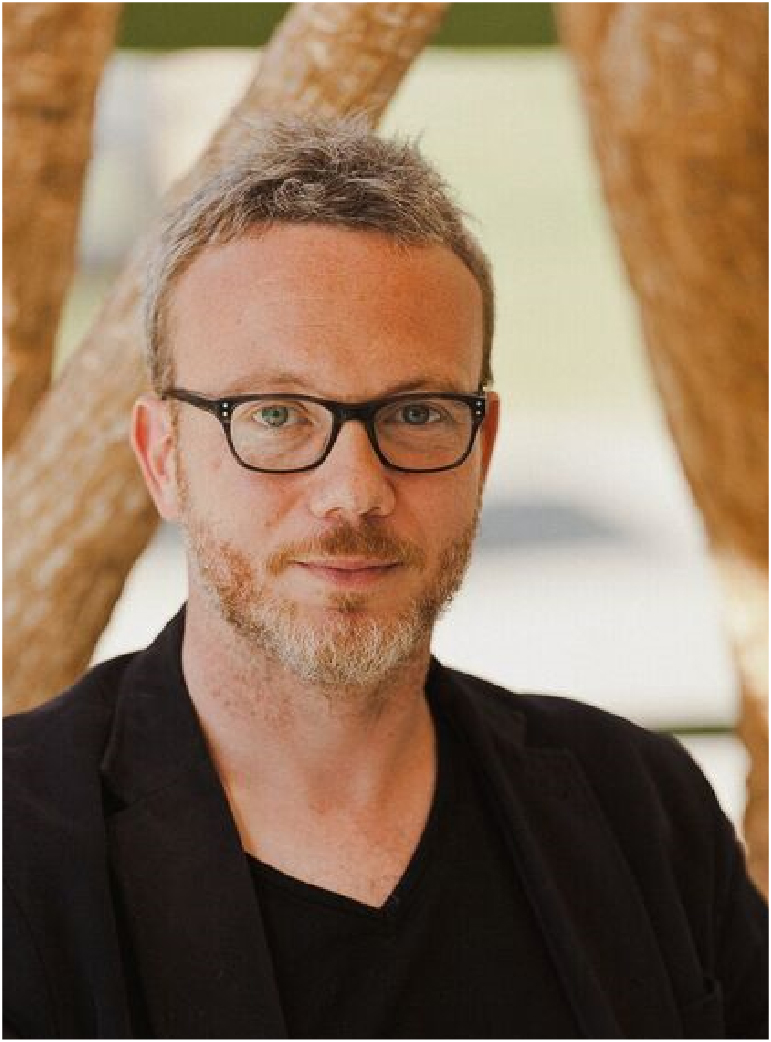
Francisco Klauser heads the Chair of Political Geography, Spaces, and Power. His research focuses in particular on the emergence of so-called “smart cities” and on connected agriculture.
He studied human geography and sociology at the University of Geneva from 1997 to 2000. There, he discovered the geographer Claude Raffestin, who specialized in the interactions between space and power. He wrote his thesis on surveillance cameras, a distinctly geographical topic with significant implications for urban life. He developed a passion for this topic, which he has continued to study throughout his academic career. After completing his dissertation, he spent five years in England analyzing various settings—such as major sporting events and the fight against terrorism, particularly in airports—where freedom of movement and the control of people flows are inextricably linked.
What approach do you take when studying the impact of a new technology on human society?
Whenever I begin new research related to the digitization of our society, I always ask myself the following three questions:
- What is the origin of this digitization—this new way of collecting and analyzing data to achieve various goals (commercial, influence, security, efficiency, etc.)?
- How do these systems work from a socio-technical perspective? The designer, the technician, and the user form a whole that I view as a new system. I try to understand whether the use of new technology is beneficial or harmful to humans. This requires going into the field to observe how it is actually being used.
For example, the usefulness of a surveillance camera cannot be described by focusing solely on the technology itself. It must be evaluated within the context of a broader system—such as a police operation (operators, patrol officers, and monitors who view the footage). - What are the implications of using these new systems: how do they influence the way we interact with one another and the way we experience urban and rural spaces?
In your opinion, what fundamental changes are brought about by digital technologies?
The social sciences focus on relationships between people. As a geographer, I am also interested in relationships with space. These relationships are mediated by intermediaries, such as the automobile, which redefines our relationship with urban space. Today, digital technology is a new type of mediator. This entails several fundamental changes. As humans, we no longer understand this mediator. For example, I use a computer without really knowing what parts make it up. I use a search engine, but I don’t know how my data is used or how it is used to learn about me and, ultimately, to influence my actions and thoughts. Thus , an opaque world is being created, controlled by technical specialists with economic interests, such as large tech companies. None of this is neutral; rather, it is becoming the foundation of our existence. More specifically, in video surveillance, if you’re a police officer, you might use surveillance systems and algorithms that, at an airport, will tell you whether a passenger is a risk or not. But you don’t understand why the system identifies that person as a risk. In the past, it was common sense and intuition—observing people’s nonverbal cues, for example—that guided us in these kinds of decisions. Today, based on predefined criteria, the computer makes the decision. In a sense, these techniques distance us from our own decisions. This sense of distance certainly explains why we remain silent and passive in the face of digital technology. It’s a virtual world that’s difficult to access.
Big Brother—do you believe in it?
I recently completed a project to evaluate the effectiveness of 30 surveillance cameras installed in the Pâquis neighborhood of Geneva. Once the initial debate had subsided—two years later—everyone had accepted the cameras and forgotten about them. We don’t consciously live with these technologies. This parallel world is becoming increasingly significant; human beings are becoming more and more transparent—and they contribute to this—while the world of data remains opaque. That doesn’t mean I subscribe to the metaphor of an all-powerful Big Brother. I don’t want to fall into the trap of the Orwellian nightmare. These technologies also bring us a great deal of convenience, speed, security, connection, and enjoyment. From my perspective, they’re much more like “Little Sisters,” to which everyone contributes.
To what extent can we talk about smart cities in 2020?
There is a significant gap between rhetoric and reality. Let me give you a few examples. So-called “smart” systems are not immune to breakdowns. Yes, they generate data, but not necessarily the data we want. Once installed, these systems are bound to evolve. These various factors mean that human intervention remains indispensable.
At the micro level, these systems are already highly effective—for example, autonomous tractors or crop-spraying drones. When used properly and integrated into an existing operational system, these tools can add value, accelerate certain types of activities, or complement what’s already in place. Drones can replace helicopters, as they are cheaper, quieter, and more precise when the terrain has been digitized. However, a new tool brings new challenges. In the case of drones, many questions remain unanswered when it comes to managing terrain with steep slopes (verticality).
What I’ve observed in the field is that human factors remain the main Achilles’ heel. In Geneva, for surveillance cameras, the operators responsible for maintenance were actually placed there through an unemployment program. This was not their profession, and they stayed for only four months, which prevented them from consolidating and passing on their knowledge. Furthermore, they were not recognized as decision-makers by the police, even though they were required to work together. This issue is not merely technical but socio-technical in nature.
Another example is the collaboration I conducted with the Neuchâtel police as part of a project funded by the Swiss National Science Foundation. Together with a doctoral student working on the project, I joined the police task force that was considering the purchase of a new drone. We supported the entire decision-making process regarding this new technology.
Indeed, the drone they purchased brings a third dimension to police work. Airspace becomes much more accessible; it becomes an everyday reality. It is more commonplace but also more dangerous, as the police must also prepare for drone accidents or even terrorist attacks. The police must therefore view airspace as an opportunity and a potential arena for intervention—but also as a space fraught with risk.
All too often, we instinctively assume that digital technology will provide the solution. We saw this with the COVID-19 contact-tracing app; a recent article reported that the app was expected to work really well by fall 2020. Yet it has been available for download for several months now. Furthermore, even if the technology works well, it may be misused by people who don’t understand it. As a result, it loses its effectiveness.
What are your upcoming research projects?
I just submitted a proposal to the Swiss National Science Foundation (SNSF) regarding COVID-19 and digital technologies. The fundamental question is this: how do we strike the right balance between security and openness?
Indeed, the first instinct was to lock down. We shut down cities and entire countries. But we realize that this lockdown approach is not sustainable. Movement and openness are essential, while maintaining an acceptable level of safety. In this paradox of openness versus closure, digital technologies allow us to isolate dangerous flows from safe ones—and thus to filter without shutting down. But as more data is collected, our freedom of movement comes at the cost of our data.
A second grant proposal is currently in the works regarding the digitization of agriculture. Our analysis will focus on farms in Switzerland and abroad to understand how digital technologies are transforming agricultural practices and processes. In addition, we aim to examine how the specific context of Swiss agriculture (topography, the agricultural system composed of small-scale producers, etc.) influences the adaptation —or lack thereof—of new “smart farming” approaches developed elsewhere.
What do you think of “surveillance capitalism”?
The digital world is not immune to a liberal logic, with a focus on optimization and efficiency, and on profit for those who sell the devices and those who use them (productivity and profitability). Today, for example, the concept of the smart city is promoted primarily as a way to increase efficiency and productivity. The idea of personal empowerment through the optimization of daily life is also frequently put forward. However, if we are part of the very systems that influence us without our realizing it (due to the intangibility of data), how can we still make decisions based on the parameters of our own lives? Can a responsible individual even exist if they no longer understand the systems around them? In my view, the role of the social sciences is crucial in making sense of these technological changes and assessing their costs and benefits.