
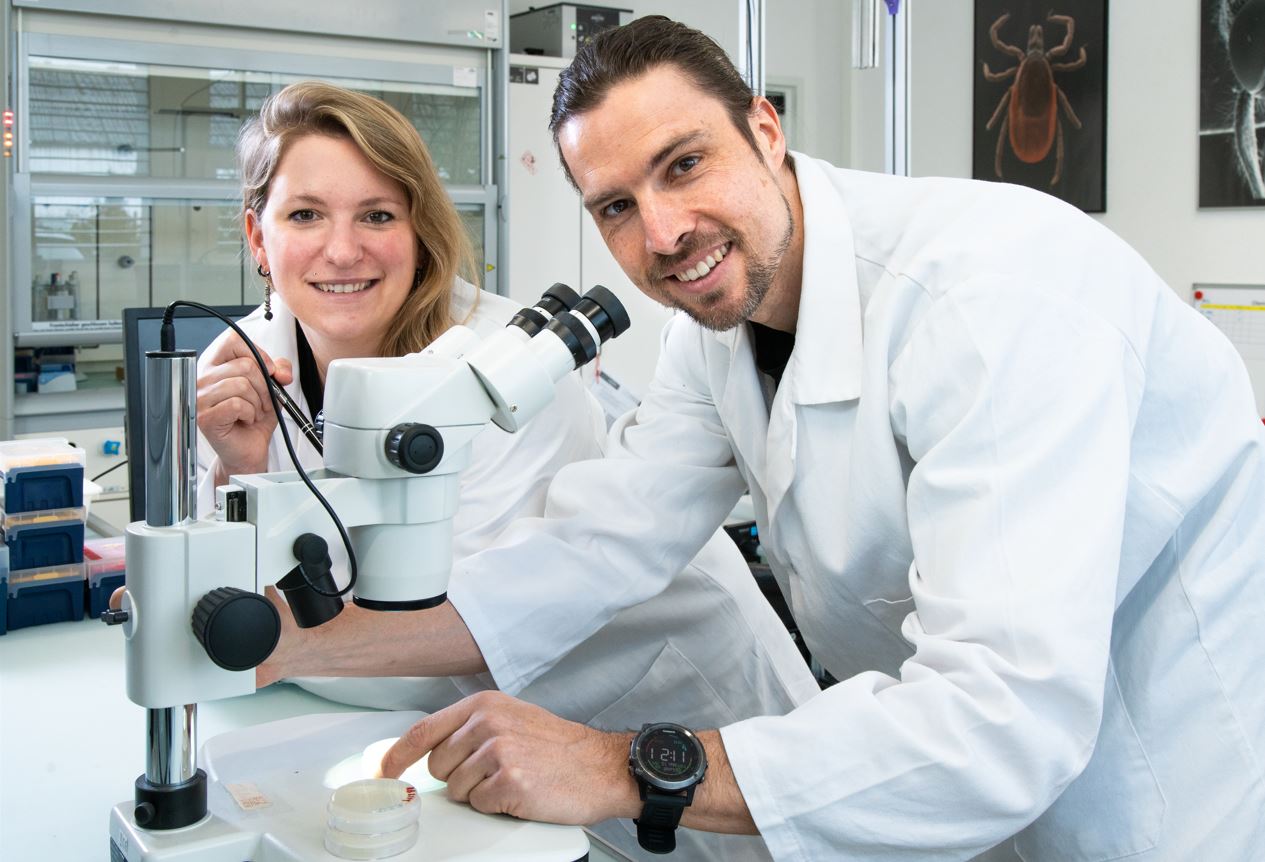
Elodie and Lucien Rufener are the CFO and CEO of INVENesis, and they are also partners in life. Passionate about the life sciences, they have taken risks to grow their startup into a full-fledged small business.
How has the company grown since 2018, when you were still based at the University of Neuchâtel?
As you mentioned, the search for new facilities took up a great deal of our time because our requirements were very specific (pure water, water supply and drainage, controlled temperature and humidity, air-conditioned rooms, etc.), without needing to meet the cleanliness standards of existing cleanrooms in the canton. In the end, we had to design our own facilities from scratch, starting with the former premises of the LEUTWILER locksmith shop in St-Blaise. It was a huge challenge, despite the support of our architect, Mr. Aradas, because we had to comply with numerous standards while remaining available to the various trades. The BCN also played a decisive role by very quickly granting us a guaranteed loan through the BCN Foundation, with the other half covered by a private guarantee. We were able to move into our new facilities in September 2020, which has significantly improved our workflow and productivity.
At the same time, we opened our new branch in Tours, France (INVENesis France), managed by our partner Alexandre Vernudachi, within the Zénoé startup incubator, which is part of the National Research Institute for Agriculture, Food, and the Environment (INRAE). This gives us access to certain pests, as well as eligibility for the research tax credit (CIR), a general measure designed to support corporate research and development (R&D) activities in France.
We have continued to work on diversifying our markets, notably by opening an office in Japan. We are collaborating with a former colleague who is based there. The Japanese are among the world’s leading chemists, and many new molecules for animal health are discovered and synthesized there. Getting started in this market has been challenging, as it requires a thorough understanding of the country’s customs and practices.
Finally, an Innosuisse project is underway. It’s a major project we secured in partnership with CSEM Neuchâtel and the Lausanne-based startup Sun Bioscience, led by two outstanding scientists who are on the rise. Beyond the research aspect, this project gives us a lot of visibility.
What is your business model?
Our motto is “drug discovery for everyone.” Our goal is to offer our services to everyone—from academia and small businesses to large pharmaceutical companies. It’s important to us that everyone has the opportunity to develop their ideas. That’s why we decided to become entrepreneurs. Our clients pay us on a per-data-point basis—that is, when we achieve tangible, shareable results.
How did you cope during the COVID-19 health crisis?
Construction work on our lab has been significantly delayed due to the virus, and as a result, so has our move. Given the current situation, we’re actually doing quite well. Throughout this health crisis, we haven’t had any order cancellations or lost any customers. However, we’ve definitely seen a slowdown in our business, with a noticeable drop in revenue. 2021 is off to a promising start with an excellent first quarter.
What are your goals for 2021?
2021 will be the year of marketing and communication. It’s very encouraging and reassuring to see that our customer base has doubled in the space of two years. We’ve created a service catalog that’s about to be released, and we plan to expand our presence on LinkedIn and update the INVENesis website.
We are in discussions with a Basel-based company active in the chemical industry to create a consortium of highly specialized companies that excel in their respective fields. This would give clients one-stop access to a range of services that, when properly combined, could also help reduce costs.
We also need to secure our supply of the pests required to conduct our tests. Our U.S. tick supplier will be retiring very soon. We are evaluating various options to ensure the continuity of this production. Without it, our operations would face significant challenges.
And what about the INVENesis team?
At the management level, now that we’re in a stabilization phase, we absolutely must consider doubling the number of staff in each position. Indeed, all of our employees are extremely competent in their fields. But if they fall ill or decide to leave, we lose essential skills that are difficult to replace on short notice. To begin mitigating this risk, we’re training our youngest team member to be versatile: eventually, he’ll need to be able to temporarily take over an absent colleague’s ongoing projects. We’re very proud of the atmosphere in our team; it’s a pleasure to come to work and experience such positive interpersonal relationships. Since we’re a small organization, it’s essential that we all pull together and move in the same direction.
Latest News: A Groundbreaking Platform for Testing New Antiparasitic Drugs, August 24, 2021