
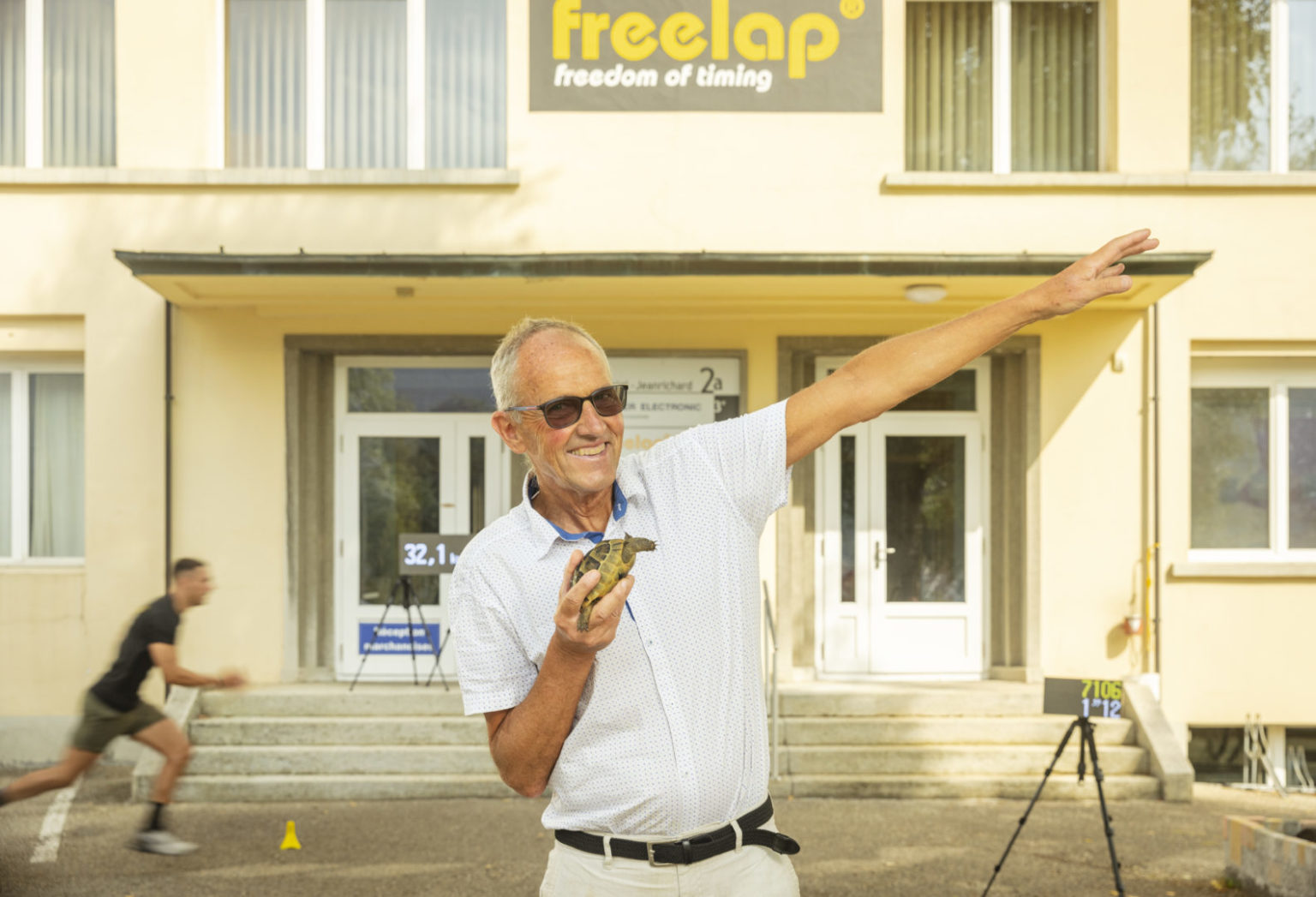
Jean-Pierre Baumann, CEO of Freelap and an athletics enthusiast, is the visionary entrepreneur behind this innovative company specializing in sports timing. In 2002, after leaving Polar, he founded Freelap with the goal of making timing accessible to all clubs and athletes by offering affordable solutions tailored to various sports. Under his leadership, Freelap has established itself on the international market thanks to innovative technologies and a vision focused on accessibility and precision.
You started your business 22 years ago. Can you tell us about the early days of this adventure?
Yes, in 2002, I founded Freelap with seven shareholders. I left Polar, a leading specialist in heart rate monitors, to launch this new company. The six other shareholders are friends of mine who had been following the evolution of heart rate monitor technology and decided to invest in this project. From the very beginning, our goal was to create timing devices that were accessible for all sports, while taking sports clubs’ budgets into account.
What were the main technological innovations you introduced in the field of timekeeping?
Our technology is based on electromagnetic beacons that emit a magnetic field detected with a level of precision suitable for sports training. Unlike traditional timing systems that use photoelectric cells and lasers, our solution is much more affordable and well-suited for sports clubs, even though it is not certified for high-level competitions such as the Olympic Games. It perfectly meets the need for precision in a training setting, offering a practical and cost-effective alternative to more expensive systems.
How do you assess the competition in the field of sports timing, and how does Freelap stand out from its competitors?
Competition in the field of sports timing is fierce, particularly from companies offering highly advanced technologies, such as laser timing or systems using photoelectric cells. However, these solutions are often very expensive and are only accessible to top-level sports clubs or events. What sets Freelap apart is our ability to offer accurate and reliable technology at a much more affordable price. We’ve designed our systems to be easy to use, portable, and tailored to the needs of sports clubs, schools, and sports enthusiasts. Our approach is to make timing accessible to a wider audience without sacrificing measurement quality. It’s this positioning that allows us to stand out and serve a market segment that many of our competitors overlook.
You also export internationally—can you tell us more about your expansion abroad?
Yes, we have a distributor in the United States that accounts for nearly 50% of our revenue. In the United States, two-thirds of the athletes who have competed in the Olympic Games use our system. Our U.S. distributor, who was previously a coach, immediately recognized the potential of our technology and has equipped many universities with our system.
What were the main challenges you faced in the beginning?
One of the biggest challenges was convincing local clubs to adopt our technology. Financial support was also a recurring issue, but we were fortunate to have friends and investors willing to increase their contributions to support us. At one point, we were even on the verge of bankruptcy with a debt of 800,000 francs, but thanks to our team’s dedication and external support, we were able to overcome these obstacles.
What role did the Department of Economics play in the development of Freelap?
The Department of Economic Development has been a key partner throughout our journey, especially during critical moments when our company was financially vulnerable. Their support helped us strengthen our venture at a pivotal juncture. They understood our vision and believed in our potential, which enabled us to weather difficult times. Their assistance was invaluable not only financially but also in terms of building our confidence and validating our venture. This gave us the momentum we needed to continue growing and overcome the obstacles we encountered along the way.
Why did you choose to stay in the canton of Neuchâtel to grow your business, and what specific strengths of the canton have contributed to your success?
The decision to stay in Neuchâtel came naturally. First of all, I’ve always had a hard time moving; I’m deeply attached to this region. But beyond that, Neuchâtel offers a unique ecosystem, especially when it comes to micromechanics and microtechnology. Local expertise has been essential. For example, Fernando Lopez, who is a pillar of Freelap, received advanced technical training here, which enabled us to develop products tailored to market needs. The quality of technical training in the canton, combined with a strong watchmaking tradition, has allowed us to stay grounded while developing highly innovative products.
What are your plans for the future of Freelap?
We are currently working on several new products, including a system capable of measuring athletes’ reaction times at the start of a race, for example. We are also developing a new app for team sports, which represents a huge market, especially in the United States. The idea is to make timing even more accessible and fun, particularly for young athletes and sports enthusiasts.
Can you tell us more about the latest innovations and products that Freelap is set to launch?
We have several innovations in the works. First, we are developing a system capable of measuring athletes’ reaction times between the starting gun and their takeoff from the starting blocks—a first in the field of training. Next, we have a new mobile app designed specifically for team sports. This app will allow coaches to track each player’s performance in real time—whether in terms of speed, reaction time, or changes of direction—all with a streamlined setup process. Finally, we’re also launching a product called “Fixmotions,” which measures not only split times but also the frequency and stride length of athletes. These innovations aim to make timing more accurate, accessible, and engaging for a wide range of sports.