
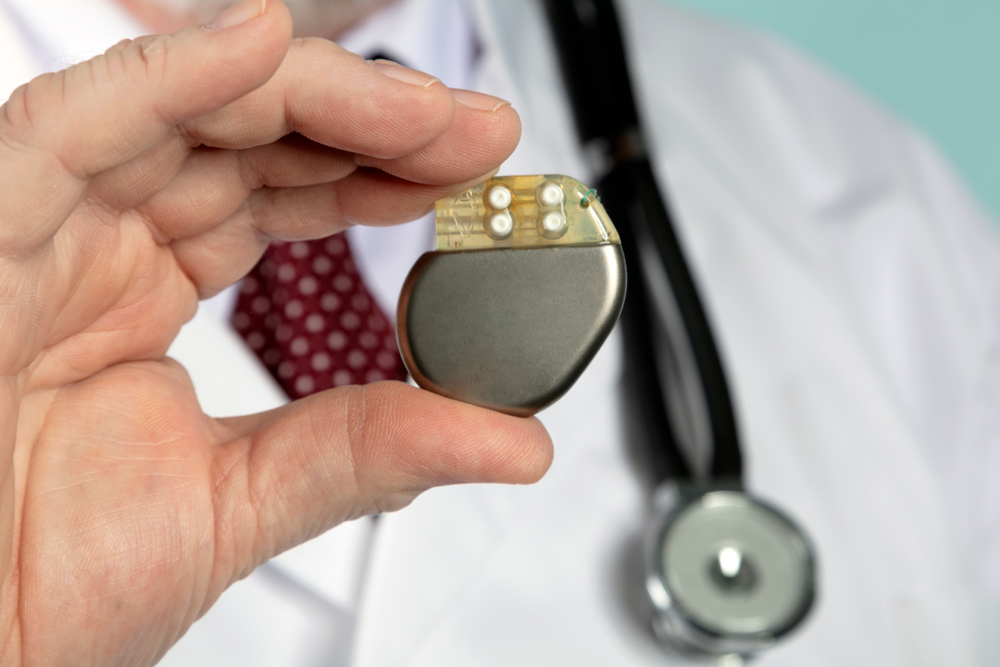
At the end of 1977, Luc Tissot recognized the importance of diversification in the watchmaking industry and, with the help of Kontron SA, founded the company Precimed. The goal of this new entity was to leverage the high level of watchmaking technology to design the first Swiss pacemaker.
Precimed Launches
In 1977, the watchmaker Tissot closed its mechanical movement factory. Branco Weiss, founder of Kontron, and Luc Tissot decided to collaborate on a new medical project: the cardiac simulator.
Following the founding of Precimed in December 1977, Luc Tissot hired Dutch engineer Gérard B.M. as technical director, along with ten employees. All of them came from the watchmaking industry and brought with them the expertise and precision characteristic of that field.
During its first year of operation, Precimed completed its first implantable pacemaker, named “Précilith”—the first of its kind in Switzerland. This device, which weighs 72 grams, is manufactured entirely in Precimed’s workshop. Nearly 18 months after its founding, and thanks to financial support from the Hoffmann-La Roche Group, Precimed produced 2,000 pacemakers. To continuously improve its device and adapt to medical advancements, the Locle-based company worked closely with the Center for Electronics and Watchmaking (now CSEM) as well as cardiologists.
A Time for Change
In April 1980, Luc Tissot, founder of Precimed, stepped down from management. He was replaced by Adrien Bussard of the Kontron Group, Precimed’s majority shareholder. Mr. Bussard would play a leading role in the adoption of the pacemaker, as he was instrumental in introducing Precimed pacemakers to all Swiss hospitals.
A year later, Kontron sold Precimed to the American company Intermedics Inc., the world’s second-largest manufacturer of pacemakers. Maintaining production in Le Locle was an essential condition of the acquisition. Precimed continued to follow its growth strategy and benefited from enhanced logistical support and greater financial resources. Intermedics, for its part, now benefited from Le Locle’s expertise in micromechanics. These developments led to the hiring of 40 new employees, followed by another 100 the following year. This was very welcome news for the Le Locle region.
Luc Tissot, for his part, will continue to develop various projects in the Le Locle region, including treatments for glaucoma and hydrocephalus. These projects will lead to the establishment of the pharmaceutical giant Johnson & Johnson in Le Locle following the acquisition of Luc Tissot’s company.
The end of a business, but the beginning of an industry for the canton
In February 1999, after more than 20 years in business, Sulzer Medics—formerly Precimed—ceased operations and laid off its 200 employees following its sale to the American company Guidant, which would continue production in Ireland. The news was a severe blow to the employees and the town of Le Locle.
As a pioneer, Precimed has provided a significant boost to the medical and watchmaking industries in the canton of Neuchâtel. Since then, other medical companies have emerged and established themselves globally in various medical fields, particularly in the field of prosthetics (Lauener & Cie, Integra Lifesciences).
The Pacemaker: Precision Like a Watch
A pacemaker is a titanium device that corrects the heart’s rhythm in cases of bradycardia (very slow heartbeat) or temporary cardiac arrest. It is implanted in the chest, under the skin, and connected to the heart via leads. It functions as a control “organ” and sends a pulse only when it detects an abnormal heart rhythm.
Just like a watch, this mechanical and electronic device must be highly accurate and operate continuously despite a hot and humid environment. It is designed to last anywhere from six to more than ten years. Each component undergoes a series of tests before assembly. Then, connection, electronic, and water resistance tests are conducted to ensure the finished product functions properly. Finally, once the pacemaker is implanted, various data are collected to monitor the patient’s physical condition and the device’s status, and to perform a procedure if necessary.
The first implantable pacemaker was implanted in 1958 by Swedish surgeon Åke Senning.
Key Dates
December 1977: Founding of Precimed
November 1978: The first Swiss pacemaker, called Précilith, was implanted in a patient
June 1979: Production of 2,000 pacemakers
November 1980: Luc Tissot left Precimed and was replaced by Adrien Bussard
March 1981: Kontron Holding SA sold Precimed to the American company Intermedics Inc.
February 1999: Sale of Sulzer Intermedics (formerly Precimed) to Guidant and closure of the Le Locle plant.