
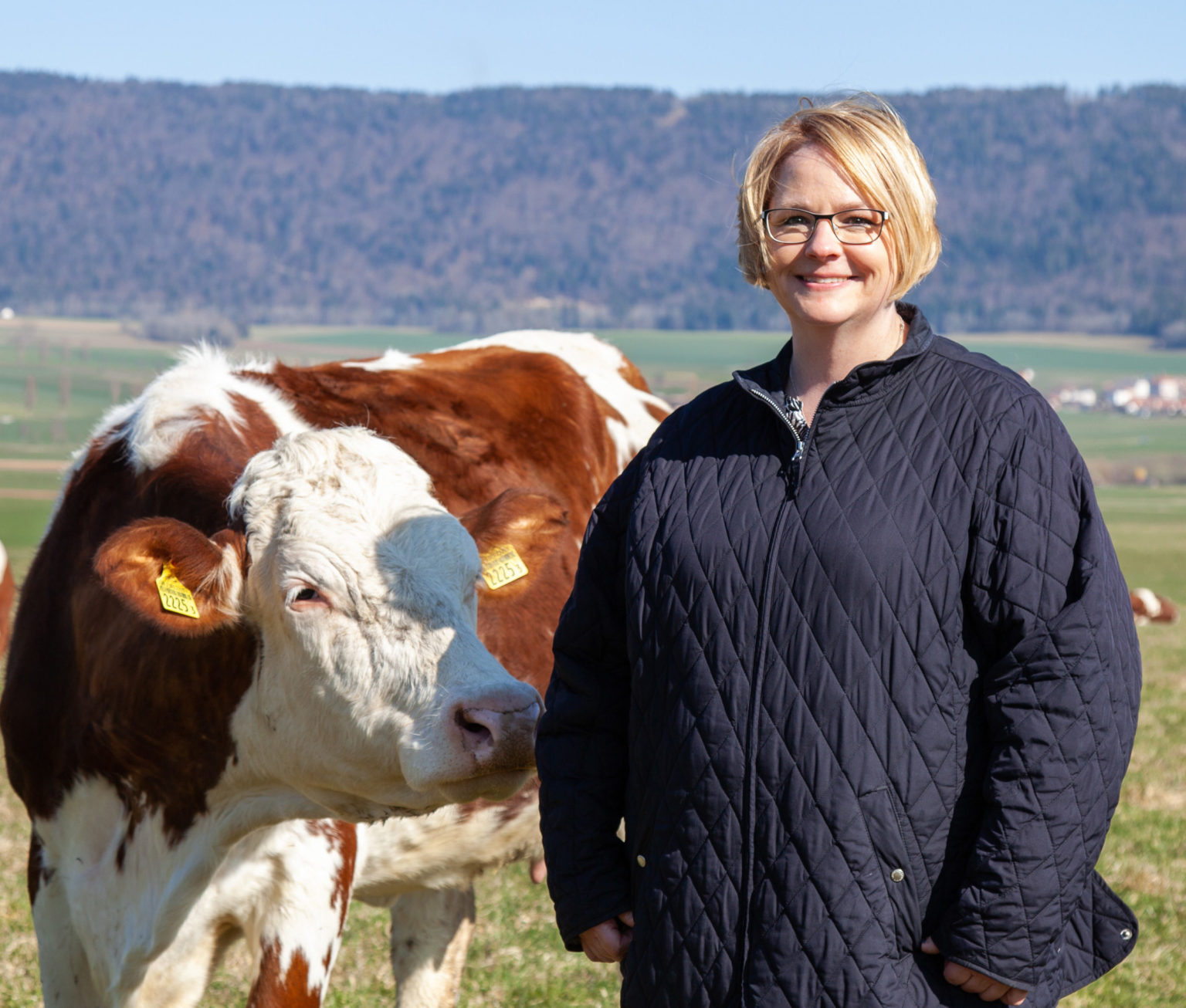
Lhney Steiner is American and was born in 1974. She grew up in central New York State, in the Finger Lakes region. She has lived in Neuchâtel Township for 8 years. She is married and has two children.
She worked for a major company in the MedTech sector until 2014. She then started her own business, L’Atelier du Fromage.
How did your arrival in Neuchâtel go?
We were welcomed warmly right from the start. Our experience in Neuchâtel was very different from that of some of our friends who live in larger cities and who had a hard time fitting in. Some of them moved away after two years, whereas here, we’ve formed strong friendships.
We’re happy to live in this beautiful place where we’ve been welcomed with open arms. When we first moved here, we didn’t speak a word of French. That didn’t make things any easier, but there’s always someone willing to lend a hand. People speak enough English, so we mix languages, and in the end, we always manage to understand each other. People do their best to help you overcome the little everyday challenges. And I’m not just talking about coworkers, who might feel obligated to do so. Sometimes complete strangers, seeing that we were having trouble, would spontaneously offer their help.
The town was also very helpful. Gorgier is a very small town with 2,000 residents. It has very few expats, but our move went very smoothly. One day, a municipal employee noticed that a letter from the canton addressed to us had the wrong address. She remembered that we had moved to a different apartment, though we were still in the same building. Such a mistake could have caused a delay in receiving the mail. So she made a copy of it, translated it into English, and sent it to us to ensure we received it quickly. We did indeed receive her translated copy before the official document from the canton. She went out of her way, even though she could have simply ignored the mistake. I don’t think we’d receive this level of service in other countries. People were truly committed to making sure our experience here was a positive one.
Was it easy to settle into the canton of Neuchâtel?
I remember a story that illustrates just how warmly we were welcomed. One of our neighbors was hosting a cocktail party and invited us by slipping a handwritten note into our mailbox. The next day, he knocked on our door to make sure we had understood the invitation, which was written in French. On the evening of the get-together, we were running late because my husband and I had to work late. What should we do? We knew that punctuality is important in Switzerland, and we were 30 minutes late. At the time, we weren’t very familiar with local customs in this kind of situation: Should we go anyway, or would it be better to cancel? Which would be the least rude? Just as we’d decided to go, someone knocked on the door. It was our neighbor, who’d come to make sure we knew how to get to his apartment.
We’ve made Swiss friends since we arrived in Neuchâtel. Eighty percent of our neighbors were Swiss, and we were the only Americans. Everyone spoke French and, to varying degrees, English, German, and several other languages. At first, our work schedules were based on American customs, which left us little time to study and learn French. I spent 12 hours at work and ate lunch at the office, which is absolutely not done in Switzerland. At home, after dinner, I would sometimes work another 4 hours. We still managed to have a social life thanks to the canton’s wide range of activities: restaurants, museums, theaters, and so on. And now that my French has improved, we feel even more integrated.
What is family life like in the canton of Neuchâtel?
After four years in Neuchâtel, there’s no doubt that we’d rather start a family here than in the United States. We want to raise our children in Switzerland.
Several of our Swiss friends have enrolled their children in Montessori-style preschools. Some families then chose to send their children to a public school for the first year of the HarmoS cycle (around age 4), while others decided to keep their children in Montessori. The great thing about Neuchâtel is that you have a choice. Switching from private to public school is no problem at all. For our part, we chose to enroll our children in a Montessori school two mornings a week, starting when they were very young (age 2). The Montessori school appealed to us because it’s a bilingual environment. We wanted a bilingual school because we speak only English at home. Although we had a part-time French-speaking nanny, we also wanted a French-speaking school environment to reinforce their language acquisition and facilitate socialization with other children. For us, starting with a Montessori school was therefore the right decision. The Montessori system focuses on empowering the child, who can choose their own activities and has a great deal of freedom to express themselves. It’s a fantastic approach that we appreciate, but it doesn’t always align with parents’ goals. As a mother, I want my children to learn French so they can fit in and make French-speaking friends. At a Montessori school, it’s difficult to ask the French-speaking teacher to spend more time with your daughter. It’s not always possible. If she prefers to speak English because she feels more comfortable with that language, the Montessori program accommodates that.
We’d heard very positive things about public schools, so we decided to enroll our daughter in the HarmoS primary program. We were worried about how this transition to public education would go, since we had no experience with it. We’d really liked the Montessori school, especially the strong emphasis on science that was integrated into the children’s education from a very young age. So we didn’t know what to expect in the public school system, but once our daughter started her new school and we saw the curriculum and activities offered, we didn’t regret our choice. The Swiss public school system offers a richer curriculum for 4-year-olds than, for example, the one I attended in the United States when I was 5. The teaching method is playful; the children don’t necessarily realize they’re acquiring new knowledge or skills, since it often takes the form of a game. The sports activities are incredible. As part of her school program, our daughter—who is completing her first HarmoS cycle—will have three months of swimming lessons with a dedicated instructor. There are also outdoor activities like La Torrée, which was a wonderful experience for her with the help of the older students. She’s also learning about recycling and gardening. We’re very impressed by the quality of public education in Switzerland. Our daughter loves school, and we’re absolutely thrilled!
How was your work experience in the canton of Neuchâtel?
We originally moved to Neuchâtel because of my job at Johnson & Johnson. Three years later, the division was relocated to Zug. I then decided to leave the company for two reasons. First, we had already grown very attached to Neuchâtel: we had friends there, our network, and I didn’t want to move to another city. Second, I was pregnant, and we decided to stay in Neuchâtel to raise our children in a place where we had already “put down roots.”
I’ve now decided to start a small business with a Swiss friend (Johana Eidam Vautherot from the Val-de-Travers region). As an expat, I find it an exciting experience to launch a business in a canton in French-speaking Switzerland. Johana and I founded a quintessentially Swiss company called L’Atelier du Fromage in September 2018. It’s a club dedicated to discovering artisanal Swiss cheeses. We offer a monthly box of carefully selected artisanal cheeses delivered directly to your doorstep. Each month, we explore a different Swiss canton and seek out the “hidden gems” found only in that specific region. We prioritize small, local cheese makers who craft their specialties using locally sourced milk. Many of these cheese makers are family-run businesses passed down from generation to generation. These cheeses carry the essence of their terroir, and each has a flavor you won’t find anywhere else. We’re fortunate to spend time with passionate people who take pride in their work and the products they craft day after day. It’s an honor for us to highlight their expertise and share their creations. We want people to learn about, share, and discover the wonderful cheeses of our country. L’Atelier du Fromage is the bridge that connects small local cheese makers with cheese lovers.
For my husband, being based in Neuchâtel is very convenient because he travels extensively throughout Switzerland and abroad. Neuchâtel is centrally located, and from here, he can easily fly out of Geneva, Basel, or Zurich. He has a wide range of flight options, allowing him to reach many destinations in about 90 minutes.
What were the main challenges you faced?
The main challenge was the initial language barrier, but there are many solutions. We decided to take classes.
Another challenge for us had to do with the variety and availability of the services we were used to. In the United States, everything can be delivered to your doorstep, from dry-cleaned clothes to takeout food. Stores often stay open late into the evening, even on Sundays. So we learned to organize our lives differently. Now, we much prefer to spend Sundays with family and friends, at the lake or in the mountains, and we have a better quality of life.
Finally, I think that even though we’ve been living here for eight years, cultural adaptation is an ongoing process. At the end of the day, we’re still Americans. We can’t escape that reality. We’re influenced by both the Swiss and American mindsets. Let me give you an example: at Montessori, you can drop off your child whenever you want within a 30-minute window. It takes 5 minutes, and then you can rush off to your next appointment. At public school, you have to wait for the teacher to come and escort the children into the classroom. From my American perspective, that’s a waste of time. But now, I appreciate this way of doing things. I enjoy walking hand in hand with my daughter. These are precious moments. It forces me to slow down and also gives me the chance to meet the other parents. These cultural adjustments are helping us learn to live like the Swiss, and we’re appreciating it more and more. We’re even considering applying for Swiss citizenship in the next 2 to 3 years…