
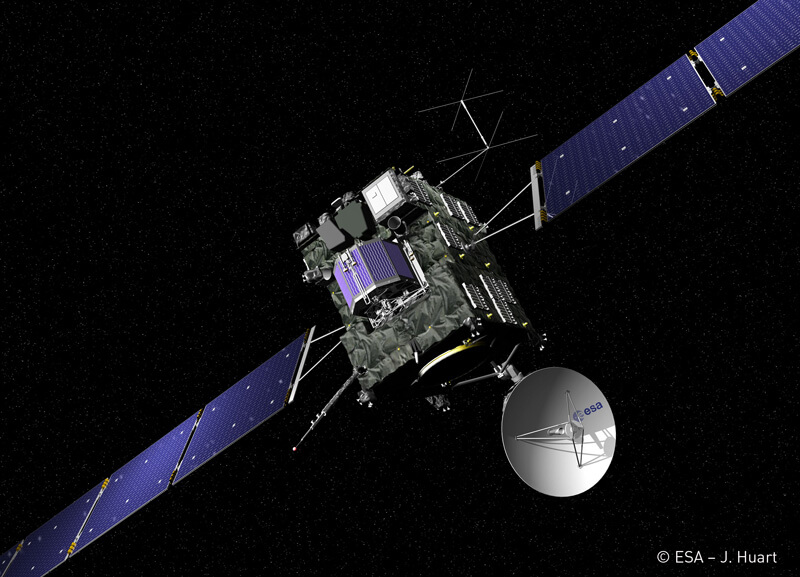
During the Rosetta mission, on November 12, 2014, the European Space Agency (ESA) surpassed its American counterpart, NASA, for the first time by achieving a historic feat: landing on a comet.
Thanks to a groundbreaking marketing campaign, the whole world is holding its breath and watching the Philae lander’s touchdown live. This live coverage is made possible in large part by miniaturized cameras…made in Neuchâtel. Neuchâtel, along with 25 Swiss companies and 14 European countries, took part in this large-scale project.
Europe Takes the Lead
It all began in 1991, when the international scientific community proposed launching a mission dedicated to comets. Two years later, a project was launched by the ESA. The goal: to travel into space and bring a comet sample back to Earth. Faced with the scale of the challenge, the space agency had to scale back its ambitions. It abandoned the idea of a partnership with NASA, decided to land on a comet rather than collect a samplefrom it , and opted not to take two landers on the mission, instead focusing on a single robot named Philae.
After a failed rocket launch in 2002, the Rosetta mission was reconfigured. The launch was postponed until 2004, and thedestination was changed. The new target is Comet 67P/Churyumov-Gerasimenko, also known as “Chury.” During its ten-year journey, the Rosetta spacecraft—carrying the Philae lander—will fly by the asteroids Steins in 2008 and Lutetia in 2010 (a secondary mission). It will then enter hibernation for 31 months to conserve energy.
The Final, Decisive Stage
When it woke up, the probe was only seven months’ flight time away from the comet—or 9 million kilometers. The mission is being monitored using images taken by the Neuchâtel-based cameras. On August 25, 2014, high-resolution images taken from a distance of about 100 km from the comet made it possible to identify five potential landing sites for Philae—a key moment in the mission. On September 29, the chosen site was announced, and the landing date was set for November 12.
On D-Day, the Philae lander, released from the Rosetta probe, would fall for 7 hours and 2 minutes. It was an interminable wait for the 2,000 people who had worked on this mission for 20 years. Despite a few moments of panic during which the lander bounced several times due to the low gravity, Philae came to rest more than a kilometer from its original target location. From this new site, data was collected over the course of three days. The cameras captured a 360° panoramic view, revealing a surface that appeared to be harder and rockier than expected.
Building on its achievements and having met 80% of its objectives, the space agency ended the mission on September 30, 2016, after the probe had also landed on the comet’s surface. Rosetta and Philae, now inactive, are expected to accompany “Chury” until it disintegrates or collides with another celestial body. The date of this end will never be known.
Neuchâtel as a Key Player
This groundbreaking project, which cost approximately 1.3 billion euros—a price comparable to that of three Airbus A380s—owes part of its success to Swiss expertise. Among the twenty or so Swiss companies involved, APCO Technologies in Aigle managed the mechanical components of the ROSINA spectrometer, which is tasked with analyzing the gases and dust escaping from the comet. The instrument was designed primarily by the Institute of Physics at the University of Bern.
Among other things, RUAG Space in Zurich developed a “sleeping bag” that was used to protect the probe from the cold and meteorite impacts during its flight. The ground-based electrical systems, meanwhile, benefited from the expertise of the Basel-based company Clemessy. As for the landing shuttle, its two engines were supplied by Maxon Motor AG, based in Obwalden.
Despite everything, one contribution to the project stands out from the rest: that of CSEM, the SPACE-X space exploration institute, led by Jean-Luc Josset. Based in Neuchâtel, CSEM designed the mission’s “eyes.” Commissioned by the European Space Agency in the early 1990s, the CSEM developed the world’s smallest digital cameras— a true technological breakthrough for its time.
People thought such an invention was impossible; it was difficult to convince them, especially since they didn't know us. But Swiss quality and our proposal won them over,
says Dr. Ivar Kjelberg, a member of the CSEM team.
An Engineering Challenge for CSEM
Between 1992 and 1997, the institute’s team—composed of about ten specialists—worked to design seven microcameras that were unique in the world. As key pieces of the puzzle, these optical components had to be part of the project and were essential to the CSEM’s success. It was a risky gamble, according to Dr. Ivar Kjelberg.
"All space travel is dangerous," he points out. "The difference is that in Switzerland, we're more expensive than other countries, so we have to set ourselves apart by undertaking special, high-risk projects."

Those years of research resulted in several prototypes. The first ones measured 35 mm high, 21 mm wide, and 1 mm thick—barely larger than a postage stamp. After months of testing, a fully autonomous, energy-efficient camera was introduced in 1998. Taking a picture required only 2 watts—a power consumption similar to that of a flashlight. The final products were delivered in 2001 and met all the requirements outlined in the mission’s specifications.
Based on Flextec technology—a titanium part and an internal spring machined from a solid block—all of the camera’s components fit together perfectly and are prepared for all kinds of challenges expected during their journey. Once aboard the Philae lander, two cameras will point in the same direction and function as a stereo vision system to provide depth perception. The other five will be positioned on all sides of the lander to provide a 360° panoramic view.
The advantage of our cameras is that they are tiny, have high-quality optics (1 million pixels), and are very lightweight, which prevents the robot from becoming overloaded,
says Dr. Kjelberg. By way of comparison, the device weighs only 100 grams—the same as half a baguette.
Overcoming Challenges
Developing such a device for an unknown environment presents many challenges.
We faced numerous challenges in designing our cameras. These included extreme temperature variations (from -150 °C to +150 °C), vacuum conditions, and cosmic radiation, all of which required great care in selecting materials. The harsh flight conditions were known, but the rest of the mission was purely hypothetical, which complicated our analyses and tests,
, recalls the CSEM researcher
Fortunately, the Neuchâtel institute has been able to find solutions. According to Dr. Ivar Kjelberg, this is due to two key factors. First, the diversity of the CSEM team’s educational backgrounds offers a wide range of possibilities. Although everyone has a background in systems engineering, each person brings their own unique set of experiences and expertise.
Second, the aspect of continuity within the company. Ivar Kjelberg, for example, has been contributing his expertise to CSEM for more than 30 years.
"That's a major advantage on a mission," he says. If someone works on a project from start to finish, they understand all the ins and outs, whereas switching operators partway through can result in a loss of valuable time.
This is an advantage that the Neuchâtel institute can claim thanks to its relatively modest size.
The Post-Rosetta Era for the Canton
Three years after the end of the Rosetta mission, the CSEM is delighted to have participated in it.
We didn't become millionaires with this project. On the contrary, we lost money, but we gained expertise and an international reputation, and that helped us find new subcontracting partners,
Dr. Kjelberg reports
In fact, companies in the region that were involved in manufacturing the cameras—such as Fisba Optik AG in St. Gallen—were able to benefit from significant international exposure through the CSEM. More broadly, Neuchâtel’s participation in this project served as a showcase for the field of micromechanics and established it as another cantonal specialty alongside watchmaking.
Like a calling card, this space mission demonstrated that engineers from the Neuchâtel-based institute could easily collaborate with major companies to achieve real breakthroughs in micromechanics. This has set the CSEM on the path to new major space engineering projects, such as the current European Remove Debris project.
Key Dates:
1993: The Rosetta Project was approved by the European Space Agency.
2001: The seven miniature cameras from Neuchâtel were delivered.
2004: Launch of the spacecraft from Kourou (French Guiana).
2008: Flyby of the asteroid Steins.
2010: Flyby of the asteroid Lutèce.
2011: The probe was placed in hibernation.
2014: Reactivation of the probe and insertion into orbit around the comet. Landing of the Philae lander on “Churyumov.”
2016: End of the Rosetta mission.
Key Information:
The mission’s objective: The Rosetta mission aimed to study, using the 21 scientific instruments on board the lander and the orbiter, the connection between comets and interstellar matter. It also sought to understand the role comets played in the formation of the solar system.
Comet Profile : Comet 67/Churyumov-Gerasimenko was discovered in 1969 by two Soviet researchers with the same name. It has a diameter of about 4 kilometers and completes one orbit every six and a half years. Composed mostly of ice, its surface is gray and rugged.
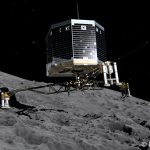
Philae's Profile: This 1.3-meter-tall robot weighs 100 kilograms on Earth but only 1 gram on the comet. For the mission, it carried ten scientific instruments (including the cameras from Neuchâtel).
Rosetta's Profile: Equipped with eleven instruments for its mission, the primary role of this three-metric-ton probe was to carry the Philae lander, which was to land on the comet.
Key findings:
- The hypothesis that the water on Earth was brought here by comets has not been confirmed by the analyses.
- On the other hand, the comet does contain the elements that could have contributed to the formation of life on Earth.
- The comet's shape is, after all, unexpected.
- This shape influences the seasons, the movement of dust on the comet's surface, and also the composition of its atmosphere.
- The gases escaping from the comet are unexpected.
- Numerous organic compounds have been detected there.
- The ground isn't soft after all—it's as hard as ice.
Videos and photos from the mission:
ESA CSEM DLR CNES Final images from ESA
Article by Julie Müller