
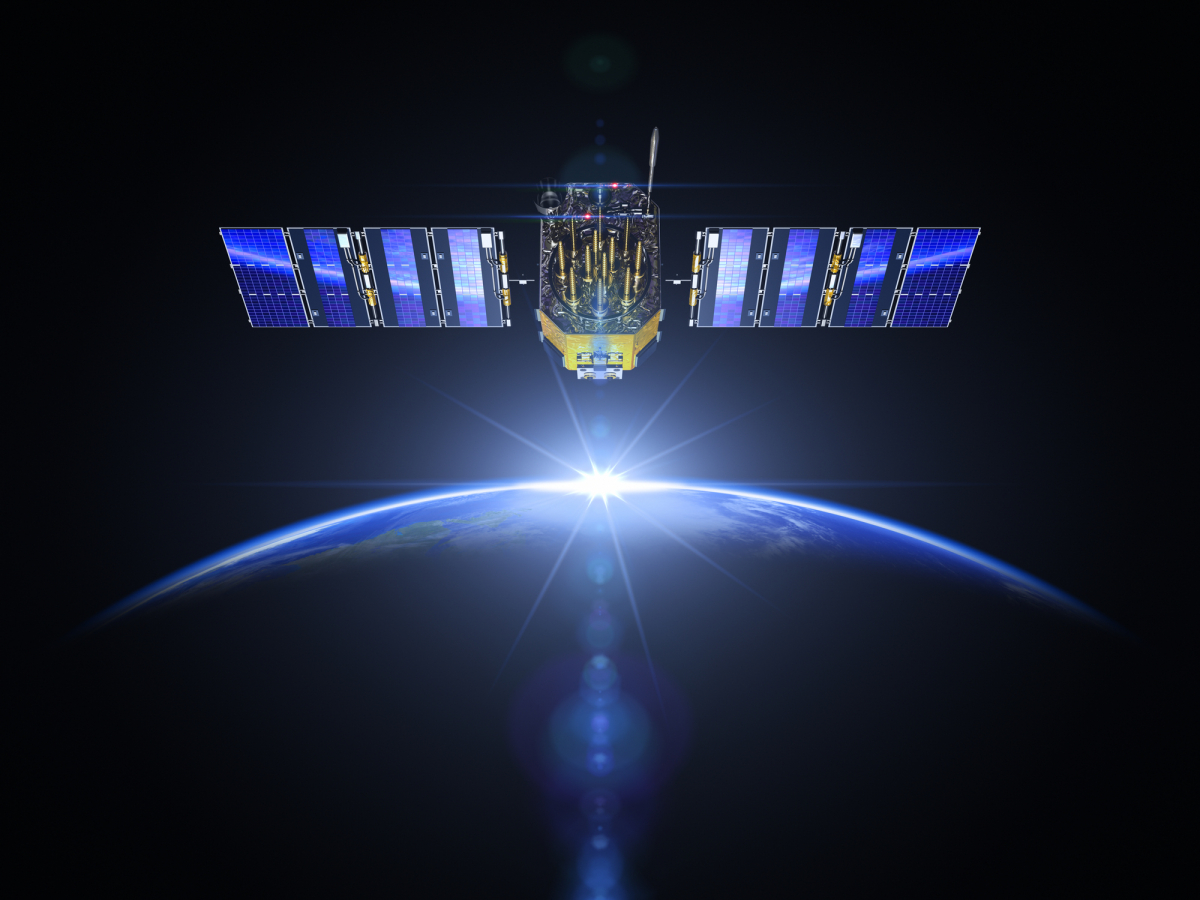
SYDERAL SWISS SA has been designing and manufacturing custom-built onboard electronic equipment for space applications for more than 25 years. The company has participated in more than 50 missions without a single failure, working with clients such as ESA, NASA, Thales Alenia Space, and Airbus.
A native of Belgium, Olivier Henin is the CEO, co-founder, and co-owner of SYDERAL SWISS. He is also the President of the Swiss Space Industries Group, which brings together companies in the space technology industry. An interview with an entrepreneur who, despite his starry-eyed vision, keeps his feet on the ground.
How is the space market organized?
Overall, the space market is divided into two major segments: satellites and launch vehicles.
In the satellite segment, for missions around Earth (some missions are launched to other planets), missions are categorized based on their operational orbits. These include LEO (Low Earth Orbit), MEO (Medium Earth Orbit), and GEO (Geostationary Orbit). The latter is located 40,000 km from Earth, which means the satellites are always positioned in the same place. They enable, for example, the transmission of a television broadcast from one side of the planet to the other. This is known as “mondovision,” with the first broadcasts taking place in the 1960s. Since then, bandwidth requirements have been growing, as have the demands for streaming and internet access. Satellites send and receive files, images, and streaming content. Space is an attractive environment because, in many scenarios, space technology is more suitable than terrestrial technologies.
The launch vehicle segment, meanwhile, is strategically very important because it provides access to space. Today, we’re talking about equipment and astronauts; tomorrow, we’ll likely see the emergence of markets such as space tourism or even logistics. Through its Ariane rocket family, Europe is very well positioned to launch both European payloads and commercial satellites. As in many industrial sectors, competition is fierce. In this case, the main competition comes from SpaceX, a project led by Elon Musk.
How has Switzerland organized itself with regard to space-related issues?
Switzerland does not have its own national space agency. In the field of research and development, it largely participates in the activities and programs of the European Space Agency (ESA). The Swiss Space Office (SSO) manages space-related matters. Despite its size, I believe that Switzerland—located in the heart of Europe and with its high-value-added expertise— has much to offer in European projects. Each year, the country contributes 150 million francs to the ESA budget. This contribution allows us to participate in decisions regarding European cooperation projects. The returns on investment are manifold: the Swiss population benefits from space applications such as those used in environmental and climate research, disaster prevention, security, navigation, telecommunications, and weather forecasting. It enables scientists to access international support programs and allows our industry to be awarded major contracts in accordance with the “georeturn” policy: for every franc invested, at least one franc must be reinvested in Swiss industry.
Can you give some examples of European space projects?
The Copernicus project is a fine example of success. Copernicus brings together all the data collected from environmental satellites and on-site measuring instruments to produce a comprehensive, global view of the state of our planet. Switzerland participated in the development of the six satellites and decided to contribute 40 million. It has already received 56 million in geographical returns. I would like to take this opportunity to emphasize that this type of project is only possible thanks to the existence of bilateral agreements. And currently, a major geopolitical risk exists for Switzerland now that the Federal Council has walked away from the negotiating table. In very concrete terms, regarding the purchase of the second generation of satellites, it is possible that Switzerland will no longer be on Europe’s order book if a political solution is not found by then.
You mentioned that the “espace” area is very attractive. Is it regulated?
You’re right to bring up this new aspect. Before, we only talked about terrestrial space and airspace. Now there’s also what I call “space,” meaning everything above Switzerland.
The first UN treaty on this issue dates back to 1967. It has undergone three revisions.
This treaty aims to regulate the use of space and define the responsibilities of states.
Today, Switzerland is considering whether to enact legislation on this issue.
For your information, Germany, a major spacefaring nation, has not established any regulations, unlike Austria, which serves as a model in this regard. As for Switzerland, the issue is very much on the agenda since no national law currently exists. Indeed, at the international level, the country hosting a satellite operator that causes property damage on Earth or in orbit would be held liable toward other states. And currently, in Switzerland, there is no law defining liability in the event of an accident. Without going into too much detail, since a satellite, by definition, must pass over many countries—some friendly, some less so—regulations will need to be established.
What new trends are you seeing in this field?
In the past, the space technology race took place in a bipolar world between the United States and Russia. Europe has succeeded in carving out a prominent position for itself as the world’s third-largest player. This is what we call the ESA’s institutional market, which primarily involves scientific and communications missions, launch vehicles, and participation in the International Space Station (ISS).
Recently, however, we have seen the emergence of a commercial market that aims to be more competitive, featuring larger series of identical satellites. Numerous new players are emerging in the United States, China, Japan, and the Middle East, to name just a few.
These new economic models are based on business models that integrate the costs of space infrastructure, launch, operations, and ground support through data utilization. As you can see, this is a strategic moment, and we must all be prepared for the emergence of this new commercial market.
What is the biggest challenge you're facing right now?
Beyond the threat looming over bilateral agreements, the strength of the Swiss franc remains a major challenge. It’s hard to find reports in the trade press suggesting that entrepreneurs have adapted. It seems impossible to me to absorb a 25% decline in profit margins over ten years. The reality is that most of us have drawn down our reserves—reserves that would be necessary for a recovery plan and adaptation to a new market.
Of course, we are constantly seeking to diversify and, if possible, secure contracts denominated in Swiss francs, which is not currently the case with the ESA and the EEC.
Offset contracts are particularly interesting in this regard. Offsets are non-standard contracts requiring that a form of economic activity be transferred from the seller to the buyer’s government as a condition for the sale of goods and/or services in public procurement. In principle, it is the foreign supplier itself that selects the Swiss beneficiaries based on their competitiveness and expertise. Hence Switzerland’s interest in maintaining its own military infrastructure.
What is your vision for continuing to recruit staff with high-value-added skills?
I’m stating the obvious when I say that Switzerland and Europe are sorely lacking in engineers. Schools train engineers; we train them in space technologies.
Every company has become so expert in its own field that we should collaborate to share these skills in non-competing areas.
For example, I am certain that engineers at SYDERAL SWISS could collaborate on projects with Medtronic, and vice versa.
To ensure we do not lose our widely recognized excellence, a cantonal or national-level initiative to support the industry could improve the situation and help break down barriers between sectors.