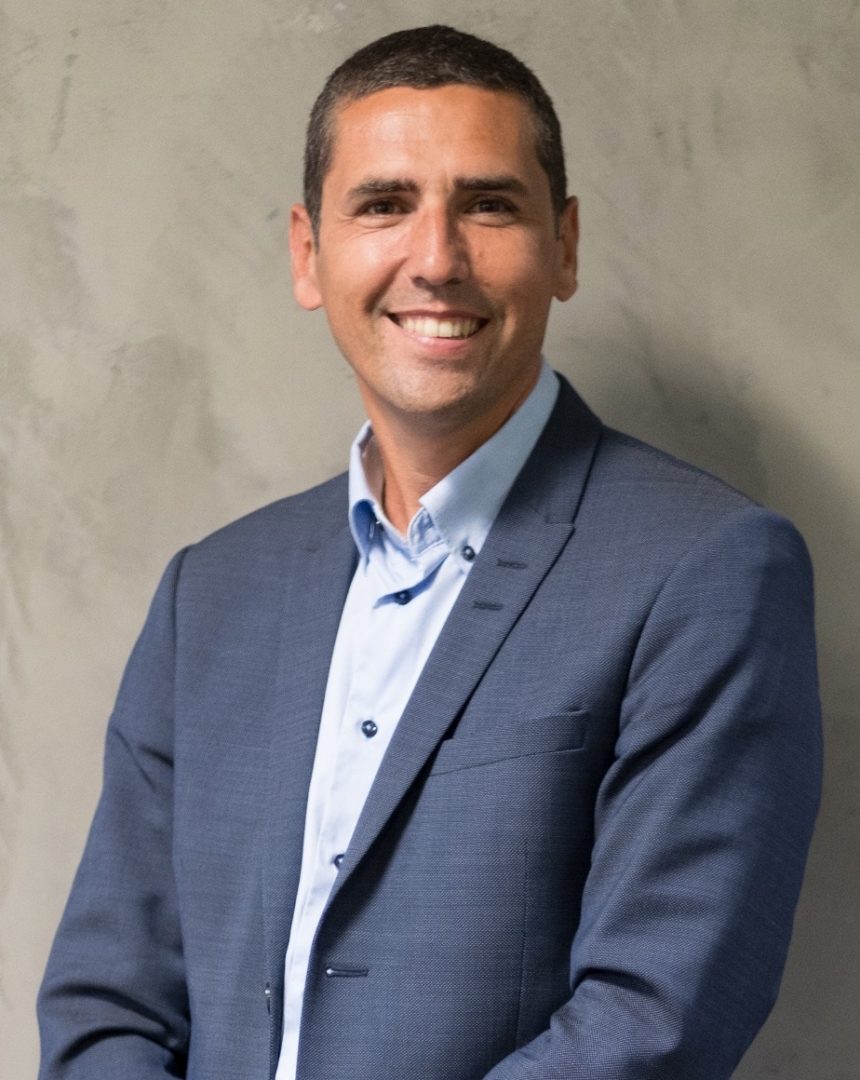
Eric Grignon has been the CEO of Sky Switzerland since 2017 and is a member of the board of directors of SKY Switzerland SA. Born in France, he moved to Switzerland in 1998 to launch the mobile operator Diax. After several years as head of engineering at Nokia and then Orange (now SALT), driven by a desire to start his own business, he joined DVDFLY in 2009 to create HollyStar, Switzerland’s largest independent OTT VOD platform. Married with two children, Eric is passionate about sailing and cooking.
Meet a man with an entrepreneurial spirit who knows how to navigate future media trends.
What do you love most about streaming?
I’ve always worked in telecommunications, and just for the record, back in April 2007, when I was working at Orange TV, I was one of the first—maybe even the very first—in Switzerland to buy an Apple TV. Back then, the Apple TV was a big box. To watch a movie, you had to download it. When I plugged it into my TV, I was amazed. I knew it was a disruptive technology that would change the way we watch TV.
In which sectors is the Sky Group active?
The Sky Group is a British company with more than 25,000 employees in England. It is the equivalent of Canal Plus in France, but with additional services, such as high-speed internet, mobile services, fiber optics, insurance, and more. It is a very large media company that has expanded across Europe and now operates in seven European countries. Its Swiss subsidiary is based in Neuchâtel, where Sky Switzerland has about 50 employees. It covers most of the country by offering streaming services (movies, TV series, and sports).
What are your main activities, services, and products?
In Switzerland, Sky has expanded in three key areas:
- Sky Sport, our flagship product. We offer a wide range of sports coverage—including soccer, golf, tennis, Formula 1, and more—with exclusive rights to certain leagues, such as the English Premier League and the German Bundesliga, for example.
- Sky Store lets you rent or buy movies and TV shows. Streaming platforms have been focusing less on movies lately and more on TV shows. But as far as we’re concerned, there’s no reason to wait two years to see a movie on TV. So we’ve purchased the rights to almost all movies shortly after their theatrical release.
- Sky Show is the “series and movies” segment based on our own productions, since Universal (Sky and NBC Universal are part of the American company Comcast) produces a great deal of content. We also have key partnerships with HBO, Sony, StarzPlay, and several independent producers. Sky has exclusive distribution rights for HBO series (Game of Thrones, Sex and the City, etc.) in German for Switzerland.
Sky is also the largest producer of TV series in Europe, with 52 series per year—equivalent to one per week. It has the largest production budget in Europe. Sky has produced, for example, *Gomorrah*, *Riviera*, *Chernobyl*, and *Babylon Berlin*. We’ve also produced a 100% Swiss series: Tschugger. The first season was a huge hit in German-speaking Switzerland, and season 2 will premiere in September 2022. It has the highest viewership ratings for a Swiss series in years.
We have two more series in the works, but I can’t reveal their titles yet.
Why did Sky Suisse set up shop in Neuchâtel, even though you have a strong presence in German-speaking Switzerland?
There’s a historical reason for this. In 2017, Sky acquired HollyStar, a company that was already based in Neuchâtel. HollyStar was a video-on-demand platform for all of Switzerland that offered movies and TV series. And HollyStar was itself the natural successor to DVD Fly, which was founded in 2003 in Neuchâtel and allowed users to rent DVDs online and have them shipped by mail. Back then, to watch a movie, you had to rent it from a specialty store and return it the next day. DVD Fly was a platform that revolutionized the online rental market. With the decline of DVDs, we launched HollyStar in 2009, which offered movie rentals, but this time the content was streamed and immediately accessible online.
What is your vision for the future of streaming platforms, and what are the emerging trends?
People are watching less and less TV and are increasingly turning to various streaming platforms like Netflix, Amazon, Sky, and Disney Plus. So, for me, the future is clearly streaming.
The problem today is that there are so many apps and platforms. It’s hard to navigate so many options, and sometimes you have to juggle them just to watch the content you want—not to mention that there’s a subscription for each app.
The future lies in trying to combine all these offerings into a single interface where you can find all the content from these platforms and see how to watch every available season of your favorite show. The main goal is to figure out how to offer you the right content at the right time without making you waste time searching for it. The algorithm behind this interface could also simplify the use of streaming platforms. For example, if you don’t watch Netflix for a month, your subscription will be automatically canceled. You won’t have to think about doing it—that will be the job of your platform “manager.”
Another trend that’s emerging is “bundle” offers that include multiple platforms for a single price—one that’s lower than if you subscribed to each platform individually.
What is the biggest challenge you're facing right now?
Our biggest challenge right now is growth. Because we’re practically doubling our revenue every year, we need more people—and therefore new office space. We’re in the process of transitioning from operating like a startup to operating like a large small-to-medium-sized business.
What kinds of people work at Sky?
In terms of job roles, on one hand we have engineers—the technical side of the company—since we provide streaming services and the applications are developed right here in Neuchâtel. And on the other hand, we have the people who manage and promote content, such as selecting movies, TV shows, and sporting events. Not to mention our customer service team.
What is your favorite place in Neuchâtel?
My favorite places in Neuchâtel are Cortaillod and Les Bains des Dames, because I love the lake so much. They’re both just magical places.
In your opinion, what could the canton do to make itself more attractive?
We should attract more companies from the service sector in general because the location is just incredible—with the lake, the mountains, and its proximity to Bern, Geneva, and Zurich.
When it comes to recruiting, we’re fortunate that France and cities like Lausanne and Bern aren’t far away. The upside is that once people are here, they tend to stay longer. We have developers who’ve been here for 10 years. So the overall conditions are really important.
To make the region even more attractive, I believe we need more jobs. Bringing in new residents would revitalize the city centers. Personally, I think Neuchâtel still has a huge amount of untapped potential in this area.