
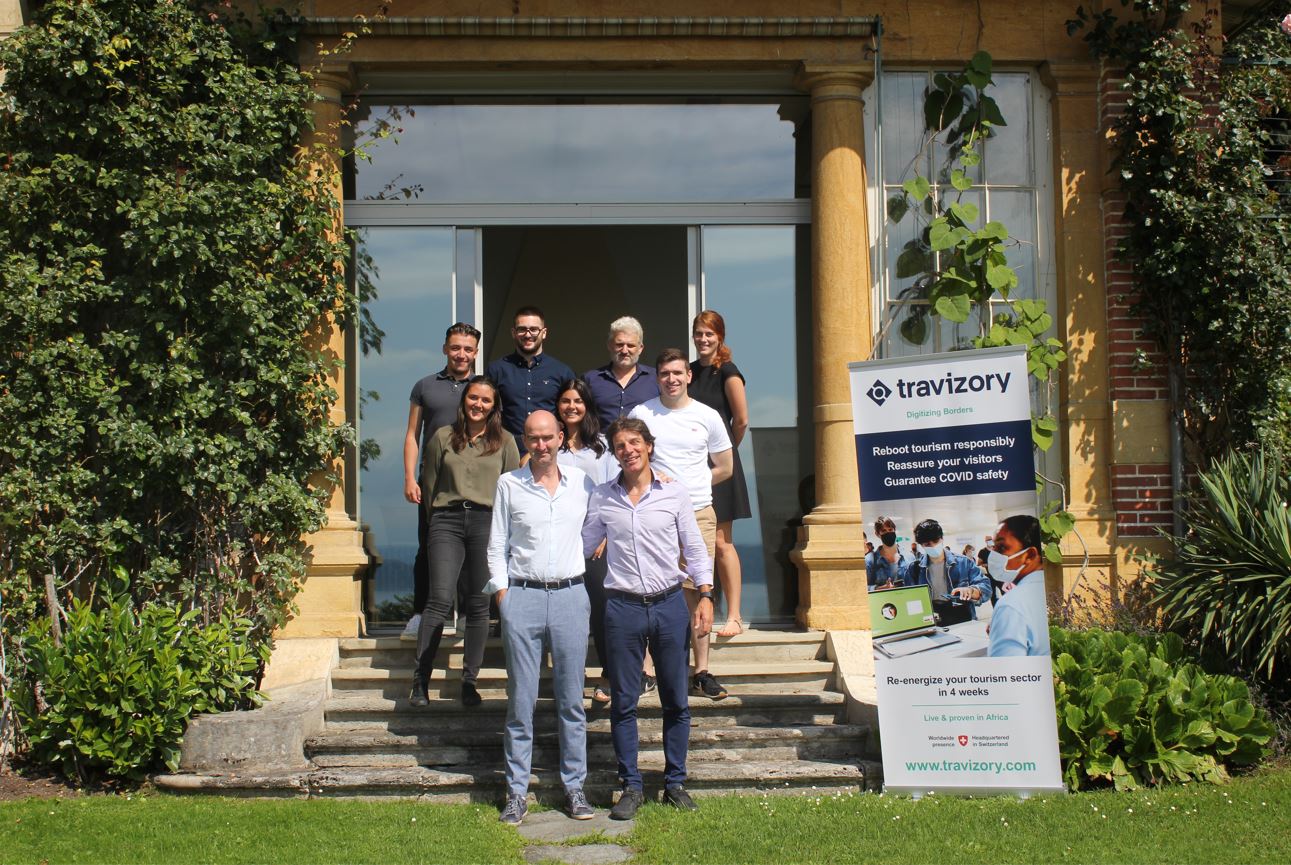
Through its visitor management platform—the only one of its kind on the market—Travizory helps countries reopen or keep their borders open in light of COVID-19 or other threats. It does so in a safer, more transparent manner, all through a fully digitized process. The system utilizes cutting-edge technologies in biometrics, AI, and machine learning.
A conversation with Ygor Lutz and Renaud Irminger, enthusiasts of digital technology applied to travel.
Why did you choose the identity management market?
We identified 150 countries that would be required to implement a travel authorization system similar to the ESTA process in the United States. This applies to countries that operate without a visa system. However, we felt that the user experience with the ESTA system was subpar and that other data sources could enhance security risk assessments. We centered our concept around the smartphone—the cornerstone of the experience—which must be capable of scanning a passport or a face, or even performing a complete “Know Your Customer” process. Our ultimate goal is to digitize border crossings, a process that currently remains heavily reliant on paper.
The Seychelles is the first country to use your solution. Why is that?
We drew up a list of criteria to test our solution, which enabled us to identify about fifteen eligible countries. Given the agility inherent in our startup operations, we needed to target a small country whose economy is heavily dependent on tourism. Furthermore, the country had to face a significant security risk—which is the case with the Seychelles: citizens from all over the world are accepted into the country, immigration is high, and the country is used as a key hub for the drug trade.
In December 2019, we had the opportunity to meet with the Seychelles’ consular representatives and the country’s president, who were looking to modernize their border control system. We submitted our initial proposals, and then the COVID-19 pandemic struck. The summer of 2020 was shaping up to be crucial for the country, which needed to quickly reopen its borders to revive the tourism sector. We were therefore able to begin implementing our solution in September 2020. It is risky to entrust a country’s security to an external company—especially a young one. A lengthy process built on trust was necessary for us to establish our credibility in the eyes of the country.
Has COVID-19 been an opportunity for Travizory?
In fact, this crisis served as a catalyst. All border control systems became obsolete virtually overnight. It was now mandatory to assess health risks. Thanks to our “startup” approach, we were able to develop a specific module in one month.
What are the main benefits of your solution?
In my opinion, there are four main ones:
- The user experience is enhanced through the use of smartphones, which centralize all necessary actions while saving a tremendous amount of time—both in preparing documents and when crossing borders. Currently in the Seychelles, it takes 15 minutes to scan a plane carrying more than 300 people, compared to two hours previously for 80 people.
- The data provided by passengers and the airline is centralized in one place, which makes it possible to cross-reference the data and thus more easily identify a health or security risk.
- Through the use of artificial intelligence and machine learning, the process is continuously improved in near real time.
- Finally, our system is based on a “drag-and-drop” interface that allows countries to configure the tool to suit their needs and modify it in real time.
Despite having traveled extensively and lived in various places, it seems you’re very attached to the Neuchâtel region?
In fact, the quality of life here is incredible, and we’re close to the airports in Geneva and Zurich, which is very convenient since we travel often.
We’ve also signed a three-year R&D support agreement with the canton, contingent on creating jobs and spending funds within the canton. It’s a positive and motivating incentive that firmly anchors us in the local community.