
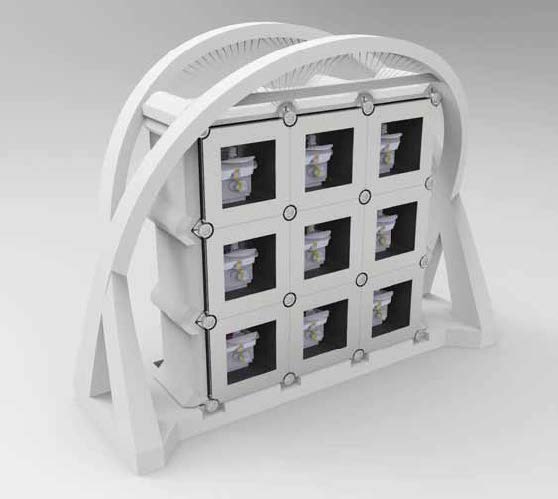
Fitting an industrial manufacturing workshop into a large cabinet containing connected machines, powered by a system of elevators: that is the challenge HE-Arc Engineering has set for itself. Autonomous and modular, the system could radically change the way small, complex, and reliable components are manufactured. Part of the human labor and the added value of industrial products would then shift to the digital realm.
This microfactory, tailored for the data economy (often referred to as Industry 4.0), will be launched as part of a partnership between HE-Arc Engineering and regional companies, notably Swatch Group and Richemont. Two other major watchmaking companies, whose names have not been disclosed, as well as several small and medium-sized enterprises, are participating in the Microlean Lab (MiLL) project.
A First Regional Success
The origins of the Microlean Lab: the Micro5 machine tool. Developed at HE-Arc in Saint-Imier, this five-axis milling machine—designed for machining micro-engineering components—was unveiled to industry professionals for the first time in 2016. Its dimensions caused quite a stir at the time: five times smaller and far more energy-efficient than its competitors, it is tailored for small parts in the watchmaking, medical, automotive, and electronics industries. Once industrialized—that is, transformed into a mass-produced product marketable by regional companies—the Micro5 made its official debut in watch manufacturing facilities in late 2019.
In the meantime, HE-Arc has made progress in designing a microfactory: for now, it takes the form of a standard structure—a sort of large wooden cabinet with nine compartments—equipped with a robotic parts-handling system and a digital control unit.
Its compartments can accommodate, as needed, the micromachines required for a given production run. Options include turning, laser engraving, 3D printing, or any other manufacturing, assembly, and inspection technique intended for microtechnology parts.
Industrial production of one-of-a-kind items
One of the founders of Micro5, Professor Claude Jeannerat, head of the production equipment design group at HE-Arc Engineering, is now in charge of the mechanical aspects of the project.He views the mini-factory as a sort of “smartphone of manufacturing”: interchangeable thanks to standardized dimensions, connectivity, and operation, each micromachine is an “app” installed according to the tasks at hand.
Professor Nabil Ouerhani, head of the Interaction Technologies group at HE-Arc Engineering, coordinates the digital aspects of the MiLL. His goal is to use digital sensors to collect large amounts of data while the machines are operating: temperature, noise, and power consumption.
All of the data, interpreted by algorithms, will enable the machine to understand what it is doing and to adjust its operation in real time, so that it produces parts that are right the first time.
According to Nabil Ouerhani, making machines autonomous would, in particular, eliminate the need for adjustment and testing work, which can currently take between three weeks and three months for the most complex parts. This would pave the way for the industrial production of small batches, or even one-off parts.
However, this is a long-term vision for the evolution of the industry, which still requires extensive development, the two engineers essentially note.
According to Max Monti, head of partnerships and commercialization at HE-Arc Engineering, the project’s cost is approximately one million francs per year over six years. Half of this will be covered by public funds, primarily from federal innovation support programs. The remainder will be provided by partner companies.
Author:LUC-OLIVIER ERARD
Source: www.arcinfo.ch