
Yann BOUTANT (President) and Gaël ROSSET (CTO), both engineers by training, met in Savoie (France) when they shared a desire to pursue a new career path. This desire naturally led them to take the plunge in 2014 and found the company KERQUEST.
Gaël worked for many years in Denmark and internationally in the telecommunications industry before returning to France in 2009. Yann, for his part, has spent most of his career in the continuous-process industry and has more than 20 years of experience in innovation in the fields of materials, sensors, and industrial systems.
A Meeting with Two Connected Visionaries.
What is the basic concept behind KERQUEST?
The basic concept is based on a bold idea: giving objects a voice so they can deliver messages. The idea is to connect objects, people, and system memories—that is, objects and information in all its forms. Objects could thus become, in a sense, messengers delivering a personal message attached to them. There are all kinds of potential objects: handcrafted or artistic objects, manufactured objects, and “natural scene” objects. We can use these objects as messaging carriers for industrial, logistical, personal, or even emotional applications. This patented concept of global messaging requires a central object recognition algorithm (for object families or individual objects). But precise and reliable recognition alone is not enough; we must contextualize the object and attach information to it to evoke emotion and/or meaning.
In what industry does your company operate? What are its main activities, services, and products?
KERQUEST was founded to work in the field of material functionalization in the broadest sense—that is, to enable the objects around us to take on new functions. Beginning in 2016, we developed the “Solid Media Messaging” technology platform, which allows users to intuitively explore any object, product, or document using a mobile device.
Most people are unaware that all the objects around us are distinct and unique by nature. As early as the 1950s and 1960s, mass production made it possible to produce more and better items of the same type, to the point where our senses can no longer distinguish them immediately. But there is an underlying physical reality that belongs to no one; everything around us is made up of unique, non-duplicable elements. Our technology draws on this reality to develop a variety of services.
Today, we can categorize our activities into three areas:
- Traceability management—that is, linking all the information about the various stages of an object or product’s life cycle to that object or product, from its creation through its end of life, recycling, or destruction.
- Property management — which involves important information about an item, such as who owns it, who previously owned it, and the secure handling of a transfer of ownership. We may also be interested in preserving the item’s integrity: Is the item still in the same condition as it was when it was sold or purchased?
- Interactivity and experience: This is achieved through a mobile app that makes the experience simple and fun, without users realizing just how complex the engineering behind it is.
We currently work almost exclusively with luxury goods and can provide our clients with a comprehensive range of services, from customized cloud environments to specific mobile applications—whether for manufacturing, distribution, retail stores, or end customers.
How did the company get off to a start?
When we first started out, we deliberately didn’t have a specific roadmap—just what was outlined in our articles of incorporation: the functionalization of materials. Instead, we focused on leveraging the founders’ expertise; they wanted to experiment together without being tied down by a rigid plan. We were really in a “brainstorming” phase. We worked on a few projects before arriving at this one. For example, we created a patented 3D cellulose molding system. It was something fairly new at the time, and we’re realizing that it’s a need that’s starting to grow. We’ve also started developing low-cost 3D scanners designed for objects.
It took us about two years to find our way and develop the “Solid Media Messaging” platform.
Our strength lies in our technical expertise; we are, first and foremost, a company of engineers with extensive experience, so we are capable of addressing a wide range of issues related to industry, processes, and technological innovation.
Why did you choose Neuchâtel as the place to set up your business and grow?
Our parent company is based in Savoie, and we quickly began serving Swiss clients. The industrial dynamism in neighboring Switzerland is far greater than what we see in France. Since a significant portion of our revenue comes from Switzerland, it was only natural that we would need to open a branch there. A friend introduced us to Mr. Thierry BAGLAN of the GGBa network, and we selected three potential cantons for our location: Vaud, Geneva, and Neuchâtel.
The canton of Neuchâtel was a very attractive location for our business, as it is an industrial canton with specialized expertise in watchmaking, micromechanics, and the pharmaceutical industry. In addition, we wanted to remain in the French-speaking part of the country for practical reasons, since the canton is close to the German-speaking part and only two hours away from our facilities in Savoie.
Thanks to the dynamic team at the Department of Economic Affairs, the entire process was straightforward and well-guided. We felt truly supported and assisted. Microcity also played a crucial role by providing us with office space and helping us settle in quickly and get off to a smooth start.
Who are your main clients and competitors right now? Authentication apps—especially for luxury goods—are all the rage, and other companies are likely working on the same issue.
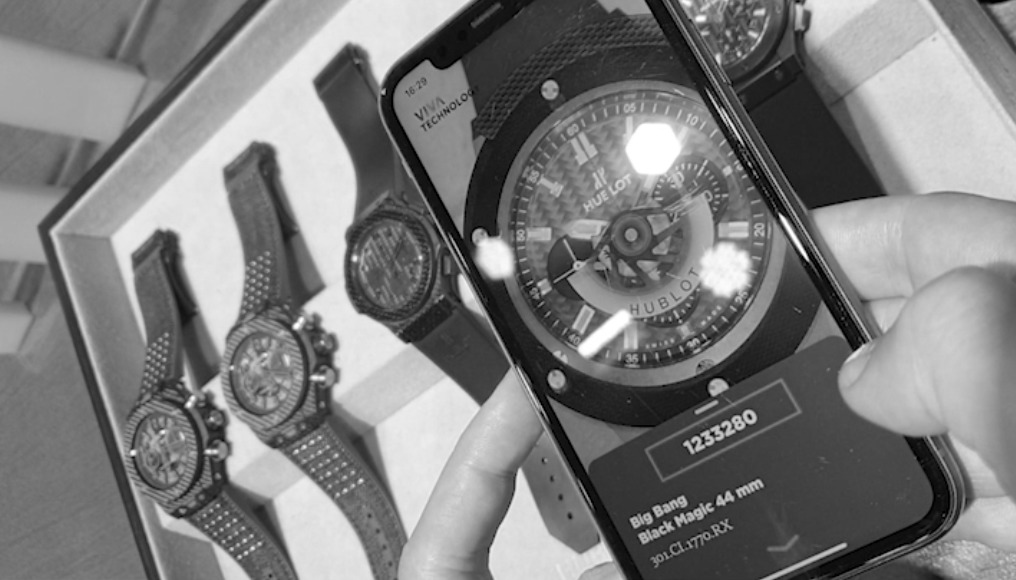
We began our interview by demonstrating our mobile app for electronic recognition and individual authentication of timepieces to show you that our technology is practical and functional.
As for our clients, they are primarily luxury brands. One example is HUBLOT SA, which issued a press release about our collaboration in November 2020. The company uses our technology as part of the Hublot e-warranty for its entire sales network and also for its end customers (https://www.hublot.com/fr-fr/news/hublot-e-warranty).
For the first time, during the 2022 edition of the Watches&Wonders fair, this same client used our technology as part of its Hublot e-warranty program during the launch of an NFT (non-fungible token) acquisition secured, among other things, by the unique identification of a timepiece (https://www.hublot.com/fr-fr/news/hublot-launches-two-nfts-takashi-murakami ).
The topic of authentication has interested people for a very long time, and when we talk about competition, it’s important to specify the application and the technical means involved. As such, we are firmly committed to never competing with our clients, which explains why we haven’t become operators of our own blockchain, for example. We partner with brands and willingly step back to let them take center stage in their communications. To date, we have no intention of being visible to the general public regarding the authentication or recognition of luxury goods. Depending on whether we’re talking about traceability, ownership management, or other areas, the competitors are very distinct, as are the technical solutions offered: these can include laser engraving, chemical tags, simple barcodes, and so on.
To the best of our knowledge, in the luxury goods sector, the maturity and adaptability of our technological solutions and services are well ahead of the competition.
You mentioned that you work on apps for the general public—could you tell us more about that?
In addition to our current business, we want to use our messaging capabilities to offer this service to the general public, who will be able to exchange messages via any physical medium. About three years ago, we began conducting research with an anthropologist to understand the human motivations behind our relationship with objects and to try to enhance those experiences through technology. Take, for example, a gift received at a certain point in time; seeing it a year later allows us to remember the person who gave it to us, on what occasion, under what circumstances, and so on. This is our biological memory at work. We propose to harness this natural trigger effect of objects with all types of digital messages and information.
How do you perceive and experience innovation within your company?
Working on innovative projects is as fascinating as it is exhausting, because we are constantly projecting ourselves into the future—into the unknown—and facing the risks of mistakes and their consequences. But we also realize that the more we invest in innovation—repeatedly and over the long term—the better we become at managing uncertainty and risk. Our daily motivation is to see our clients embrace our technology and create use cases that we may not have necessarily thought of ourselves. It is precisely at that moment—when the technology becomes as transparent as it is useful to our client—that we have achieved our goal as engineers.
How do you envision your company in 5 to 10 years?
It’s challenging to position ourselves as an independent technology company. The technology we’ve developed has the potential to become the industry standard in the field of augmented authentication, and we’re working toward that goal. On a personal level, we’ll likely still be innovating and developing. Our driving force is to innovate and try to develop products and services five years ahead of the curve that will become “must-haves.” We develop more in a “techno-push” mode than a “market-pull” mode. We’re constantly trying to anticipate the future—first from a technological perspective—and to assess whether this new technological approach has something to offer potential markets.
In your opinion, in what areas could the canton still make improvements to enhance its appeal to businesses?
Everything went perfectly for us, so we can’t think of any ways the canton of Neuchâtel could improve. We are therefore very grateful to the canton, and we truly appreciated our relationship with the Department of Economic Affairs. We received excellent support, which continues even after we’ve set up our business.